

How to Respond to Negative Google Reviews (With 12 Templates That Actually Work)
Talk to any local business owner long enough and a 1-star review will come up. It's usually the same vent: "This is completely unfair. They never even said anything to us. Should I call them? Can I get it taken down?" The honest answer is rarely what they want to hear. You probably can't get it removed, calling them rarely helps, and the response you're tempted to write at 11pm is the one that's going to sit on your profile for the next four years.
Here's the good news. One well-written reply to a bad review does more for your conversion rate than ten 5-star reviews. The next person reading your profile isn't really looking at the 1-star itself. They're looking at how you handled it. That's where trust gets built or burned. This post covers the framing, a four-part anatomy for responses that actually land, twelve templates for the situations I see operators run into most, and the moves that quietly make things worse even when you're right.
What a Negative Review Actually Costs You
Most owners assume a bad review costs them whatever rating points it pulls off the average. Honestly, that's the smallest piece of it. The real cost is that prospective customers, the ones who would have called, read the review, read your response, and quietly decide. They don't tell you they didn't book. They just don't book.
I've seen businesses lose between 5% and 15% of their inbound calls in the month after a single unhandled 1-star, and recover almost all of it within thirty days of posting the right response. The reviewer isn't the audience. The audience is the next hundred people reading your reviews while deciding whether to spend money with you. That reframes the whole thing. You're not writing to the angry customer. You're writing past them, to everyone else who's reading over their shoulder.
There's a second cost that matters for long-term Google performance, and that's signal. A profile with a steady mix of reviews and thoughtful owner responses gets treated by Google's ranking system as an active, legitimate business. A profile with one ignored 1-star sitting at the top of the page doesn't. Responses are a ranking input as much as a trust input.
Why Most Owner Responses Make It Worse
The default human reaction to public criticism is to defend yourself, and the default reaction to feeling unheard is to over-explain. Both of those show up in roughly 80% of the negative-review responses I read in the wild, and they almost always make the business look worse than the original review did.
Here's the pattern. A customer writes something unfair or exaggerated. The owner replies with a 400-word point-by-point rebuttal that mentions the customer's name, references their order details, corrects three factual errors, and ends with "we hope you reconsider your review." The owner feels relieved. The reviewer feels humiliated and digs in. Every future customer reading that thread thinks, I don't want to be on the receiving end of that energy.
The other failure mode is the corporate non-response. "We're sorry you had a less than ideal experience. Please contact us at info@..." That tells the next reader nothing, except that the business won't really engage when something goes wrong. It also looks templated, because it is.
The response that works lives between those two failure modes. It's short. It's specific enough that it clearly wasn't pasted in. It acknowledges what's worth acknowledging without conceding what isn't true. It moves the actual back-and-forth offline. And it's written for the person who'll read it next month, not the person who wrote the review last night.

The 4-Part Response Anatomy
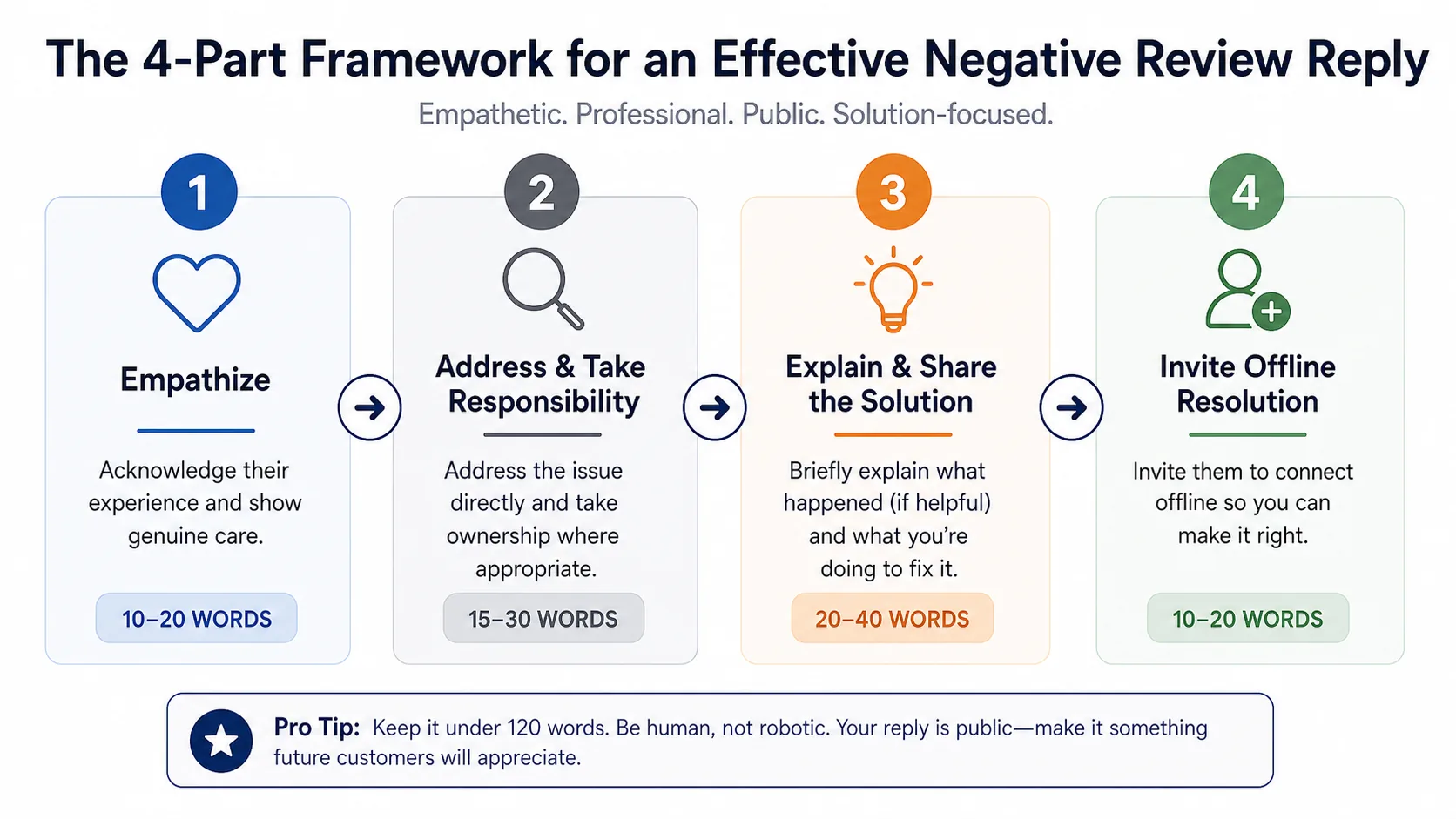
Almost every effective response to a negative Google review has the same four parts, in roughly the same order. Once you internalize the shape, you can write any response in about ninety seconds without re-reading the review three times.
The first part is acknowledgement of the specific thing. Not "we're sorry you had a bad experience." Something like "thank you for flagging the wait time on Saturday." That proves you actually read it, and it signals to the next reader that you're paying attention. The trick is to acknowledge the topic without conceding facts you don't agree with. "Thank you for raising the billing concern" is honest even when the billing was correct.
The second part is a brief, neutral statement of context or position. One sentence, that's it. "Our Saturday morning slot is usually our busiest window, and we don't always hit the timing we want." This is where most owners blow it by adding three more sentences. Resist. The next reader is filling in the gaps in your favor as long as you don't over-explain.
The third part is the offline invitation. A direct, named contact path with your name, an email, and a phone, plus the offer to make it right. Putting your actual name in the response signals that a real person runs this place. It also makes it much harder for the reviewer to keep performing for an audience once you've handed them a private channel.
The fourth part is the close that resets tone. One short, warm line. Something like "We appreciate you taking the time to share this, and I'd like the chance to make it right." Not groveling, not stiff. Just human.
That's the whole shape. Four parts, usually under 75 words. Anything longer and you're writing for yourself, not for the next reader.
12 Templates for the Most Common One-Stars
These templates are starting points. Personalize the specifics (names, situation, offer) or they'll read like everyone else's templates. Each one assumes you've already calmed down. If you haven't, write the response, save it as a draft, and look at it again in the morning before you post.
1. The rude or aggressive customer (where the facts are mostly wrong)
Thank you for taking the time to share your experience. We hold our team to a standard of treating every guest with respect, and what you've described isn't consistent with what I'd expect from our staff. I'd like to understand what happened, so please reach me directly at [name@business.com] or [phone] so we can talk it through. — [Owner first name], Owner
2. The legitimate complaint (you actually did mess up)
You're right, and I'm sorry. We dropped the ball on [specific thing] and that's not the experience we want anyone walking out with. I'd like to make it right. Please reach me at [name@business.com] and we'll get this sorted. Thank you for telling us; it's the only way we get better. — [Owner first name]
3. The employee-specific issue (named staff member)
Thank you for letting us know. The interaction you described isn't how we train our team, and I take it seriously. I'd like to hear more about what happened so I can address it internally. Please reach me directly at [name@business.com] or [phone]. — [Owner first name], Owner
Note: never agree publicly that the named employee did the thing. You'll handle that internally. The public response acknowledges the topic without trying the case in public.
4. Food or service quality
I'm sorry the [dish / service] didn't meet expectations on your visit. Consistency is something we work hard at, and clearly we missed on this one. I'd genuinely appreciate the chance to make it up to you. Please email me at [name@business.com] and I'll take care of it. — [Owner first name]
5. The pricing complaint
Thank you for the feedback on pricing. Our rates reflect [one short, neutral reason: sourcing, expertise, time], but I understand it's not for every visit or every budget. If there's something specific about your experience you'd like to discuss, you can reach me at [name@business.com]. — [Owner first name]
Do not get drawn into defending the price line by line. One sentence of context, then offline.
6. The wait-time complaint
Thank you for flagging the wait. We aim to keep [appointment / table / service] times tight and clearly fell short on the day you visited. I'd like to understand what happened on our end, so please reach me at [name@business.com]. — [Owner first name]
7. The billing dispute
Thank you for raising this. Billing concerns are something we want to resolve directly rather than back-and-forth in a public thread. Please reach me at [name@business.com] or [phone] with your visit date and I'll personally review it with you. — [Owner first name]
Never quote the customer's invoice details publicly. Even if they did first.
8. The "this place has gone downhill" review (no specifics)
Thank you for the feedback. I'd genuinely like to understand what's changed for you. We've made [or: haven't made] significant changes lately, so any specifics you can share would help. Please reach me at [name@business.com]. — [Owner first name], Owner
9. The mistaken-identity review (wrong business)
Thank you for the review, but I think there may be a mix-up. We don't have a record of a [service type] on the date you mentioned, and the description doesn't match our [location / menu / services]. If you can reach me at [name@business.com] I can help track down where you may have visited. — [Owner first name]
This is the cleanest case for asking Google to remove the review later. More on that below.
10. The competitor or fake review
Thank you for the feedback. We don't have a record of your visit in our system, and we'd like the chance to verify the details. Please reach me directly at [name@business.com] with your appointment date so we can look into this. — [Owner first name], Owner
Do not accuse them of being a competitor in the public response, even if you're sure. Document it, respond cleanly, and flag to Google separately.
11. The "never even let us fix it" complaint
I'm sorry to hear this is the first we're learning about it. I wish we'd had a chance to address it at the time of your visit. I'd still like the opportunity to make it right. Please reach me at [name@business.com] or [phone]. — [Owner first name]
12. The unreasonable demand left as a 1-star
Thank you for sharing your experience. The request you've described isn't something we're able to accommodate as part of our standard service, and I'm sorry that wasn't clearer ahead of your visit. If you'd like to talk through options, please reach me at [name@business.com]. — [Owner first name], Owner
The shape is the same across all twelve: specific acknowledgement, one neutral line, named offline path, warm close. The actual work is in resisting the urge to add a fifth sentence.
What Not to Do (No Matter How Wrong They Are)
A short list of moves that look fine in your head and reliably backfire in public.
Don't share private information. Order details, appointment specifics, medical context, billing amounts, the fact that they were a no-show last month, the fact that they were drunk. Even if they brought it up first, the moment you confirm it publicly you've crossed a line the next reader will notice. For regulated industries like dentists or vets and anything HIPAA-adjacent, this isn't a judgment call. It's a violation.
Don't mention lawyers, legal action, defamation, or "we're consulting counsel." Even when the review is genuinely defamatory, threatening legal action publicly will reliably get screenshotted, posted to local Facebook groups, and turned into the new top result for your business name. If you actually have a legal case, talk to a lawyer privately and let them handle it. The public response says nothing about it.
Don't argue facts line by line. If the reviewer says they waited 45 minutes and you know it was 18, the response is "thank you for flagging the wait time," not "actually our records show you were seated in 18 minutes." You will win the factual argument and lose the next ten customers.
Don't ask them to take it down. Not in the response, not in a follow-up email, not ever. Asking for removal in public makes it look like you care more about the score than about the customer. If the review violates Google's policies, flag it to Google directly. If it doesn't, live with it and write the best response you can.
Don't respond when you're angry. Write the draft, close the tab, sleep on it. The version you write in the morning is always shorter, calmer, and better.
Don't respond more than once. One reply, public, done. If they reply to your reply, let it sit. The audience for the thread isn't the reviewer; it's the next reader, and the next reader stops reading after the first owner response anyway.
When (and How) to Take a Reply Offline
The whole point of the public response is to move the conversation to a private channel. The offline path needs to be real, named, and easy. "Contact our customer service team" isn't a real path. "Please reach me at sarah@business.com" is.
Once you're in private, the goals shift. Now you're actually trying to understand what happened, fix it if you can, and (only if it feels natural) let the customer know you'd appreciate an updated review once their experience changes. Never demand an update. Never offer anything in exchange for one. For why incentives are the wrong move regardless, see my post on paying for Google reviews. Just resolve it like a human and let them choose what to do with the review.
Roughly 30% of the customers who actually engage offline will update the review on their own. Another 30% leave it but soften toward the business over time. The other 40% go silent, and that's fine. The public response you wrote is doing the work either way.
Should You Ever Try to Get a Review Removed?
Sometimes, yes. Google will remove reviews that violate their content policies: spam, fake content, conflicts of interest (former employees, competitors), off-topic content, personal attacks, inappropriate content, or content that clearly references a business the reviewer never actually visited. They won't remove reviews just because the business disagrees with them, and the threshold for "fake" is higher than most owners think.
If you've got a genuinely policy-violating review, the path is to flag it from your Google Business Profile dashboard, document why, and wait. Removal can take days to weeks, sometimes longer, and a meaningful fraction of legitimate removal requests still get denied on the first pass. It's worth doing for clear violations. It's a waste of energy for "they were rude and I don't think their description is accurate."
While you wait, the public response is doing the heavier lifting anyway. By the time Google reviews the flag, your reply has already been read by everyone who was going to be influenced by the original. Either it gets removed and you stop worrying about it, or it stays up with your calm, named, specific response sitting underneath. Both outcomes are survivable.
If the broader question for you is how to build a profile resilient enough that one bad review barely moves the needle, the answer is volume of recent reviews. A 4.7 average across 412 reviews absorbs a 1-star without flinching. A 4.9 across 19 reviews doesn't. The fastest legitimate way to get there is in my pillar post on getting more reviews, and the Google Business Profile setup that supports it is in the profile optimization guide.
Frequently Asked Questions
Frequently Asked Questions
- Can I get a fake or unfair Google review removed?
- Sometimes. Google removes reviews that violate its content policies, including spam, conflicts of interest, off-topic content, and personal attacks. Flag from the GBP dashboard, document why, and expect days to weeks for review. Removal is denied often, so write the public response either way.
- Should I respond to negative reviews if I disagree with them?
- Yes. The reply is written for the next 100 customers reading the profile, not for the reviewer. Acknowledge the topic without conceding facts you do not agree with, move the conversation offline, and keep it under 75 words.
- How long should I wait to reply to a 1-star Google review?
- Write a draft the same day, but post the next morning. The version you write at night is almost always longer and more defensive than the version you write after sleep. Aim to post within 24 to 48 hours.
- Should I ever ask a customer to remove or update their negative review?
- Do not ask in public, and never offer anything in exchange. After resolving the issue offline, you can mention you would appreciate an update if their experience has changed, but never demand or incentivize one.
- Does responding to negative reviews help my Google ranking?
- Yes, indirectly. Google treats consistent owner responses as a signal of an actively managed profile, which feeds ranking. The bigger lever is what the next customer reading the thread decides to do.
- What should I never say in a public response to a bad review?
- Do not share private details (order info, billing amounts, medical context), do not threaten legal action, do not argue facts line by line, and do not ask the customer to remove the review. All of those make the business look worse to the next reader.
The temptation with a bad review is always to fix that review. The owners who play this game well stop trying. They write the four-part response, send a calm offline note, and put their energy back into the system that brings the next twenty reviews in. That's the only thing that actually moves the average. If you'd rather not write each response from a blinking cursor at 11pm, ThankYouReview drafts a first pass for every new review the moment it lands, in your voice, ready to edit or send.
Keep reading
How to Get More Google Reviews in 2026: A Playbook for Local Operators
A practical, end-to-end playbook for getting more 5-star Google reviews without bribing customers or breaking Google's policies.

Google Review Email vs SMS: What 100,000 Sent Requests Actually Showed Us
We ran the data on tens of thousands of review requests sent via email and SMS. The conversion gap is bigger than most owners realize.
Can You Pay for Google Reviews? What Google's Policy Actually Says
Paying for reviews is against Google's policy — but the line between incentive, gift, and bribe is fuzzier than most owners think.