

Can You Pay for Google Reviews? What Google's Policy Actually Says
This question comes up at least once a month, usually phrased carefully. "We were thinking of offering customers a free drink for a Google review, is that allowed?" Sometimes it's a $10 gift card. Sometimes it's a draw for an iPad. Sometimes it's an employee bonus tied to how many 5-stars they personally generate. The owner asking is almost never trying to do something shady. They're trying to grow the business and they've watched a competitor do something similar with no obvious consequences. The question deserves a real answer instead of a hand-wave.
Short answer: no, you can't pay for Google reviews. The longer answer is that the line between "incentive" and "thank-you gift" is blurrier than most owners realize, enforcement has gotten more aggressive, and when Google catches it the cost is way bigger than the upside ever was. This post covers what the policy actually prohibits, where well-meaning owners walk into trouble, what happens when you get flagged, why the buying-reviews industry is a worse deal than it looks, and the legitimate alternatives that produce more volume than any incentive scheme.
The Short Answer (and Why It's More Complicated Than That)
No. You can't pay for Google reviews, you can't offer discounts in exchange for them, you can't put customers in a draw for leaving them, you can't give employees bonuses based on the reviews they personally collect, and you can't preview the review before deciding whether to send the customer to Google or to a private complaint form. All of those are policy violations under Google's prohibited-content rules.
The reason this isn't a clean "no" is that some of what's prohibited looks identical to things owners already do for unrelated reasons. A coffee shop gives loyalty customers free drinks. A salon already gives stylists bonuses tied to customer retention. A dental practice follows up with patients to see how the appointment went. None of those are violations on their own. They become violations when the trigger, whether that's the reward, the bonus, or the routing of the follow-up, is tied to leaving a Google review.
That's the line. A reward you'd have given the customer anyway is fine. A reward you're giving because they wrote a review, or that you'd only offer if they agreed to write one, isn't. Most of the gray-area situations owners get into are really arguments about which side of that line a specific tactic sits on.
One more thing worth saying up front. This is Google's policy, not law, in the same way "no shoes, no service" isn't law. Google can remove your reviews, suspend your profile, or quietly filter your future content if they decide you're breaking the rules. They don't owe you due process or an explanation. And once your profile is suspended, getting it back is measured in weeks, not days.
What Google's Policy Actually Prohibits
Google's review content policy is publicly posted and worth reading in full at least once. Paraphrased, the relevant parts for this conversation are roughly:
Reviews have to reflect a genuine, voluntary experience with the business. Businesses can't offer or accept compensation for reviews. Compensation includes money, but also discounts, gifts, free products, services, loyalty points, contest entries, and anything else of value. The policy explicitly covers offering incentives to customers, paying third parties to generate reviews, and asking employees or family members to leave reviews. It also prohibits review gating, which is soliciting reviews selectively from customers you expect will leave positive ones, as a form of deceptive content.
The policy also covers the inverse. Businesses can't pay to have negative reviews removed (which doesn't really work anyway), can't ask customers to remove or update negative reviews in exchange for anything, and can't post their own reviews or have employees do so.
What's allowed: asking customers for reviews without conditions or incentives, responding to reviews, flagging policy-violating reviews for Google to evaluate, and giving customers a frictionless path to leave a review if they want to. That's the entire legitimate playbook. Anything outside it is risk.
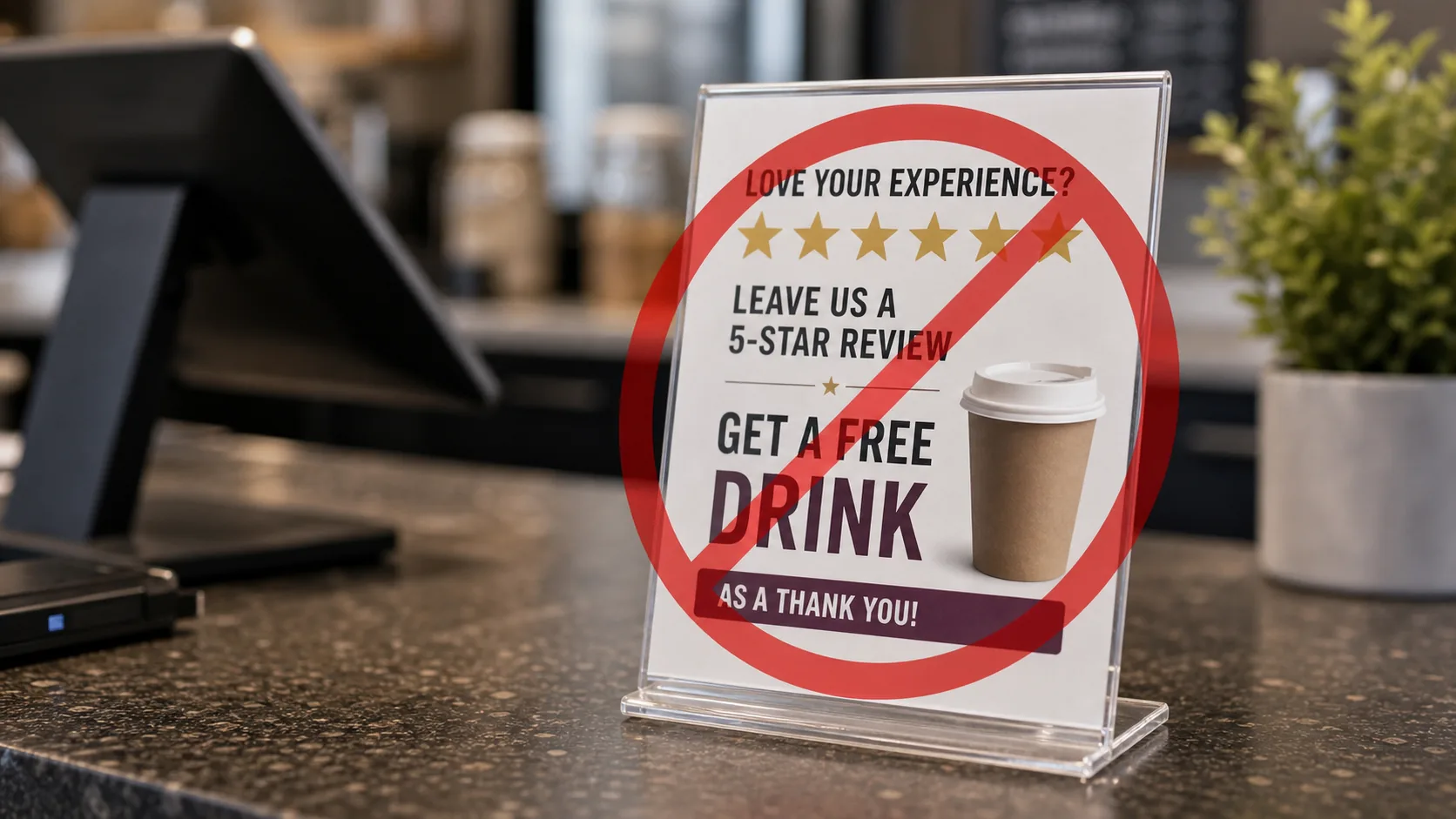
The piece owners miss most often is that the policy applies to the offer itself, not just the transaction. If you put up a sign that says "leave us a 5-star review and get a free coffee," you've already violated the policy whether or not anyone takes you up on it. The signage is the violation. It's evidence of conditional incentive on the part of the business. People who assume they're safe because they didn't actually hand over the coffee are reading the policy wrong.
The Gray Areas Most Owners Walk Into
The clean cases are easy to spot. "$10 off if you leave us a 5-star review" is obviously prohibited. The gray cases are where most well-meaning owners get themselves in trouble.
The "thank you" gift that's actually an incentive. Owner sends a $5 Starbucks card with a handwritten note thanking the customer for leaving a review. Feels personal. Feels like a nice small-business gesture. Google's policy treats it as compensation if it's tied to the review, even retroactively. The fact that you sent it after the review already existed doesn't matter. What matters is whether you'd have sent it if they hadn't reviewed. If the answer is no, it's an incentive.
The contest or draw. "Everyone who leaves a Google review this month is entered to win a $200 gift card." Textbook violation, and the one I see most often on local-business social media. Doesn't matter that not everyone wins, or that the prize is modest. Conditional entry to anything of value in exchange for a review is the violation.
Employee bonuses tied to reviews. Owner tells the team they'll get $20 for every review that mentions them by name. Most owners think of this as an internal motivation tool rather than a customer-facing incentive, but it pushes employees to lean on customers in ways that often slip into pressure, fake reviews from friends and family, or worse. Google's policy explicitly covers compensation that flows through employees, not just directly to reviewers.
A close cousin: tying performance reviews or promotions to Google star count. Same problem, slower fuse. The behavior it incentivizes (gating, soft pressuring, asking friends to review) is exactly the kind of thing Google's filtering algorithms are trained to spot.
Review gating. This one's the sneakiest because it doesn't feel like incentivizing at all. Owner builds a flow that texts every customer a private survey first. If they rate 4 or 5 stars, they're sent to Google. If they rate 1, 2, or 3 stars, they're routed to a private feedback form the business can handle quietly. Some platforms used to market this as a feature. Google explicitly prohibits it. They're a lot better at detecting it than they were three years ago, and a profile flagged for gating can lose maps visibility, not just have individual reviews pulled.
The honest test is whether you're asking everyone, or only the happy ones. If it's only the happy ones, you're gating. The fix is to ask everyone the same way and let the chips fall.
"We only ask happy customers." A softer version of gating that owners often defend as common sense. The logic is that an upset customer probably isn't going to leave a review anyway, so why prompt them. Two problems with that. First, you can't actually predict who's upset, so you're filtering based on customers you think were happy, which is just a bias machine. Second, Google's systems pick up on the pattern. A profile whose review velocity correlates strangely with customer mix starts to look engineered, and engineered profiles get filtered. Ask everyone.
Asking family and friends to review. This one feels like it shouldn't count because the relationships are real. Google disagrees. Reviews from people with an undisclosed relationship to the business are policy violations, and the detection here is more sophisticated than people assume. Shared addresses, shared devices, shared payment histories, suspicious clusters of early reviews from accounts with thin histories. A new salon opening with eight reviews in the first two weeks from accounts that have never reviewed anything else is a pattern, and Google sees it.
What Happens When Google Catches It
Enforcement isn't always immediate or visible, which is part of why owners talk themselves into thinking the risk is hypothetical. In practice it's more of a quiet escalation than a sudden hammer.
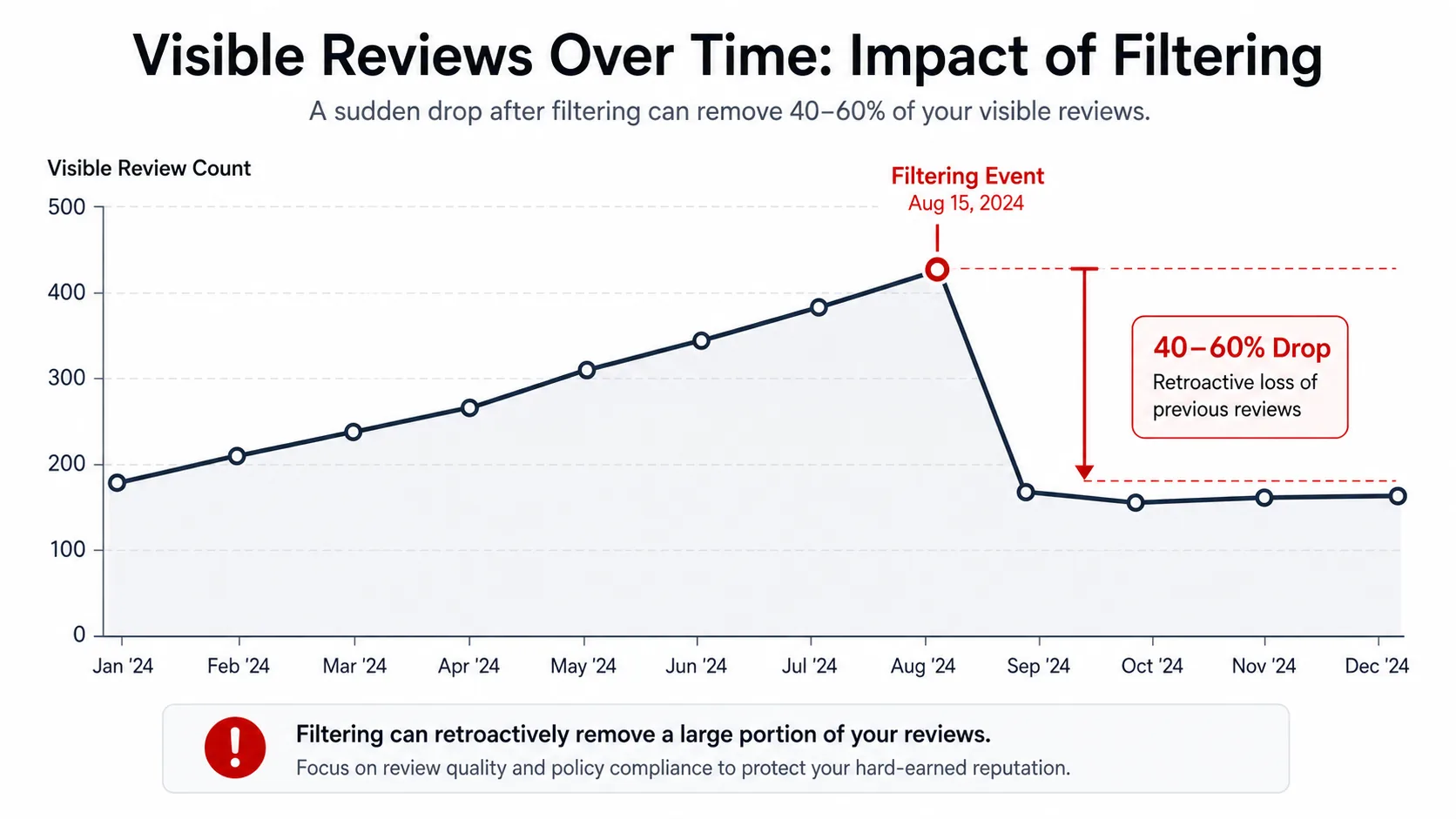
The first thing that happens, and it happens to a large chunk of incentivized review campaigns, is filtering. Reviews that look incentivized, gated, or otherwise non-organic get suppressed. They might still show up on the public profile, or they might not, but they stop counting toward the visible average and stop contributing to local search ranking signals. The owner sees the review count tick up while visibility ticks down and can't figure out why.
The second thing is removal. Once Google's systems classify reviews as policy-violating with enough confidence, they disappear. No notification, no warning, no appeal. The review count drops, sometimes by significant percentages overnight. I've seen profiles lose 40-60% of their reviews in a single sweep after years of running incentive campaigns that had been "working fine."
The third thing is profile suspension, and this is the one that ends businesses. If Google decides the profile is being used to systematically break policy, they can suspend the whole listing. Suspended profiles disappear from Maps and from local search results. The business effectively becomes invisible on Google. Reinstatement is possible but slow, and it requires showing that the violating practices have stopped. For a business that gets 60% of its inbound from Maps, even a two-week suspension is brutal.
The pattern to internalize: the upside of incentivizing is bounded, maybe 30-50% more reviews in the short term, and the downside is unbounded, up to and including losing the entire Google presence the business depends on. Even on pure expected-value math, it's a bad trade.
The Buying-Reviews Industry (Don't)
There's a parallel industry that skips the incentive question by skipping the customer entirely. Various services, easy to find and openly advertised, often based outside the US, will sell you Google reviews directly. Five reviews for $50. Twenty for $150. They're written by people who never set foot in the business, posted from accounts that exist purely to post them, and at a glance they're hard to tell from real reviews.
Don't do it. Three reasons.
One, it doesn't work. Google's spam detection on review fraud has gotten dramatically better in the last few years. The patterns these services produce, things like bursts of generic reviews from accounts with thin histories, reviews mentioning the right business in the wrong city, or reviews that match templates other businesses also bought, get flagged in waves. Owners who buy reviews routinely watch them disappear within weeks.
Two, it brings broader scrutiny on the profile. Google doesn't just remove the fake reviews. They look harder at everything else. Legitimate reviews can get caught in the filtering. The profile picks up a quieter visibility penalty that's hard to attribute and harder to reverse.
Three, in the US the FTC has been actively pursuing businesses that buy fake reviews under deceptive-endorsement rules. The fines are real, the precedents are recent, and the agency has signaled they're going to keep enforcing. A few hundred dollars in fake reviews can balloon into a regulatory matter that costs orders of magnitude more.
The same goes for "review removal" services that promise to scrub negative reviews. They either don't work, work briefly before the reviews come back, or work by getting your profile flagged in ways that hurt you long-term. Treat both ends of that industry as off-limits.
What to Do Instead — and Why It Works Better
The legitimate path produces more volume than incentivizing ever would, without putting the profile at risk. The whole playbook lives in the pillar post on getting reviews, but the short version is three behaviors.
Ask everyone, every time. Not just the customers who seemed happy. Not just the regulars. Every customer who walked in or got served, automatically, the same way. The single biggest lever in review volume is the percentage of customers who get asked at all, and most businesses are sitting at 10-15% while they think they're at 80%.
Ask fast, in the warm window. Within an hour of the experience, by SMS instead of email, with a two-line message and the link first. I dig into the timing and channel choice in the email vs SMS analysis. Inside the warm window, conversion rates from a clean message run 25-30% with no incentive at all. Outside it, they're 2-3% even with one.
Respond to every review that comes back. Real, specific thanks for the 5-stars. Measured, public responses for the 1-stars (covered in the negative-review post). Responding tells Google you're an active business, and it tells the next customer reading the reviews that there's a real person paying attention.
Run those three behaviors consistently for a quarter and you'll produce more reviews than any incentive scheme ever has. And the reviews don't get filtered, don't get removed, and don't put the profile at risk. The bonus is that the system is durable. Incentive campaigns work for a few months until Google catches up. A clean ask-everyone-fast system works indefinitely.
The other thing worth setting up alongside the ask system is a properly optimized Google Business Profile. A well-structured profile with accurate categories, services, hours, and photos converts profile views to calls at much higher rates than a half-finished one, which means each review you do collect is doing more work. The profile optimization guide walks through the setup.
Frequently Asked Questions
Frequently Asked Questions
- Can I offer a discount or free product for a Google review?
- No. Google's content policy prohibits any compensation for reviews, including discounts, gift cards, free products, loyalty points, and contest entries. The offer itself is the violation, whether or not anyone takes you up on it.
- Is it against Google's terms to enter reviewers into a prize draw?
- Yes. Conditional entry to any prize or drawing in exchange for a review is a textbook policy violation. The fact that not everyone wins or the prize is modest does not matter.
- Can I give employees a bonus for the Google reviews they collect?
- No. Google's policy covers compensation that flows through employees, not just directly to reviewers. Bonuses tied to review counts also push staff toward gating and fake-review behavior, which gets the profile filtered.
- What is review gating and is it against Google policy?
- Review gating is asking customers privately first and only routing the happy ones to Google. Google explicitly prohibits it and has gotten meaningfully better at detecting it. Gated profiles can lose visibility, not just individual reviews.
- What happens if Google detects fake or paid reviews on my profile?
- Google's response escalates: filtering (reviews stop counting), removal (reviews disappear in batches), and in serious cases full profile suspension. Suspended profiles vanish from Maps and can take weeks to reinstate.
- Is buying Google reviews from a service ever a good idea?
- No. The reviews almost always get caught and removed in waves, they trigger broader scrutiny that hurts legitimate reviews, and in the US the FTC has been pursuing fake-endorsement cases with real fines.
- Can I thank a customer with a small gift after they leave a review?
- Only if you would have sent the gift regardless of whether they reviewed. If the gift is tied to leaving the review, even retroactively, Google treats it as compensation and a policy violation.
The temptation to take a shortcut on reviews is understandable. Competitors look like they're getting away with it, the legitimate path takes patience, and the math on a $5 incentive per review looks great on a spreadsheet. The problem is that spreadsheet doesn't account for filtering, removal sweeps, or the day Google decides your profile is too dirty to keep around. The boring path of asking everyone, asking fast, and responding to everything quietly outperforms every shortcut over a long enough timeline. It's the path ThankYouReview was built to make automatic.
Keep reading

How to Get More Google Reviews in 2026: A Playbook for Local Operators
A practical, end-to-end playbook for getting more 5-star Google reviews without bribing customers or breaking Google's policies.

How to Respond to Negative Google Reviews (With 12 Templates That Actually Work)
12 copy-and-paste response templates for one-star reviews, plus the framing that turns a complaint into a public win.

Google Review Email vs SMS: What 100,000 Sent Requests Actually Showed Us
We ran the data on tens of thousands of review requests sent via email and SMS. The conversion gap is bigger than most owners realize.