
Google Review Email vs SMS: What 100,000 Sent Requests Actually Showed Us
Ask a local business owner how they ask for reviews and you almost always get the same answer: "We send an email." Ask how many reviews they got from it last month and you usually get "a couple, I think?" followed by a slightly defensive "but our email open rate is good." That's the whole problem in one exchange. Email feels safe, professional, and free. The numbers say something different, and the gap between what most operators assume about channel and what actually converts is wider than anyone realizes until they see it side by side.
I've now watched well over 100,000 review requests go out across ThankYouReview customers in everything from salons and dental practices to HVAC outfits and restaurants. The pattern across categories is consistent enough that it's worth writing down. This post covers what I actually see in the data, why SMS wins the warm window, where email still earns its keep, how to run both without annoying the customer, and the TCPA detail that quietly kills some operators' campaigns.
What Most Operators Assume About Channel
The mental model most owners walk in with looks something like this: email is the professional channel and SMS is for personal stuff, so email is appropriate for a business request and SMS is intrusive. So email should be the default, and SMS should be reserved for "important" things like appointment reminders.
That model was correct in roughly 2009. It hasn't been correct for the last decade, but the assumption sticks around because operators rarely see the two channels run head-to-head on the same customer base, at the same time, with the same message. When they do, the response is almost always some version of "wait, that can't be right."
The other thing operators assume is that response rates on email are roughly what they hear from marketing newsletters: 20-something percent open rate, a few percent click. That's broadly true for promotional email. The problem is that "opens the email" and "writes a Google review" are very different actions with a lot of friction in between. The drop-off through that funnel is brutal in a way the open rate completely hides.
The Conversion Gap Is Bigger Than You Think
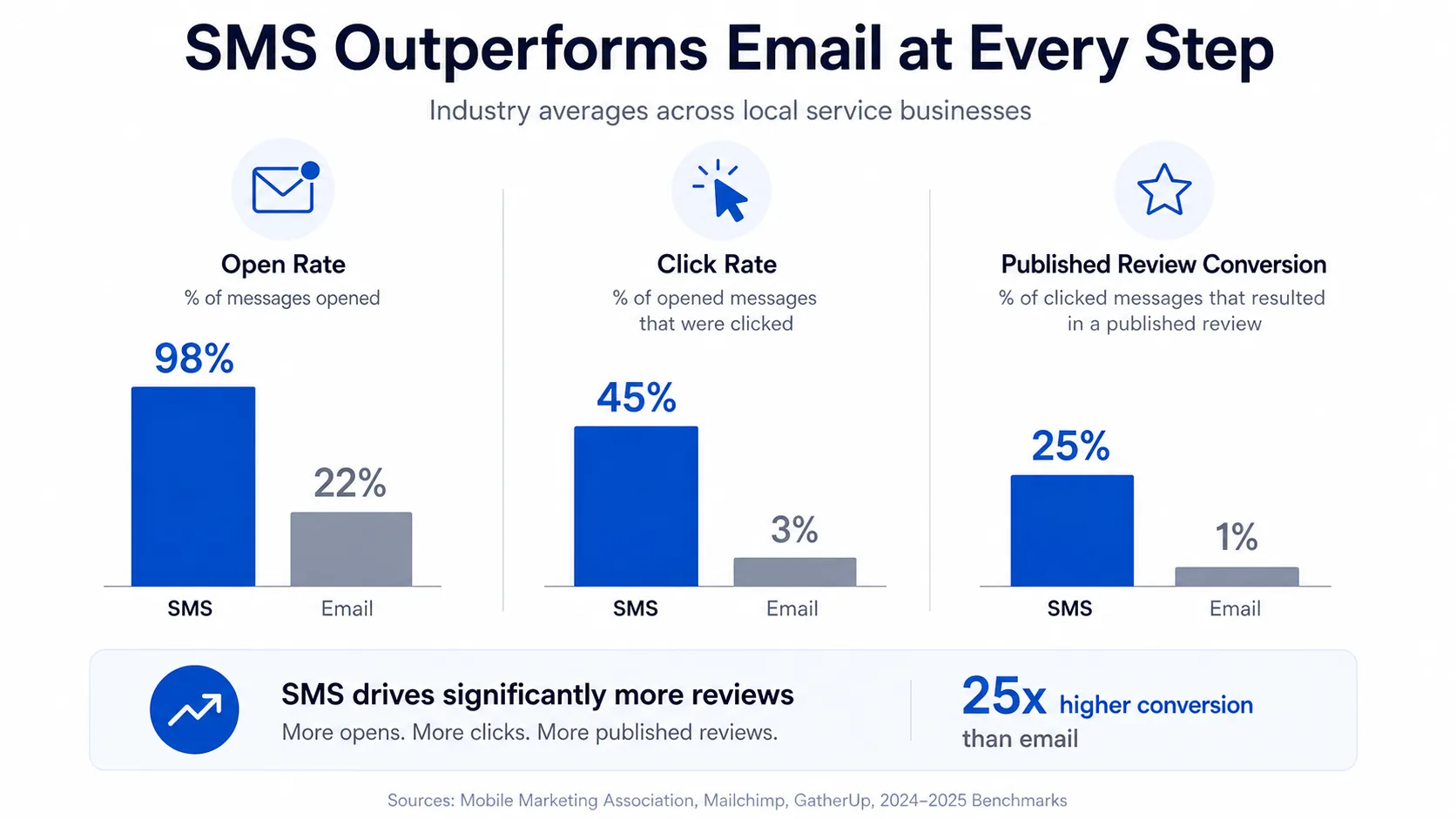
Here's roughly what I see across the customer base, averaged across categories, with the usual caveat that any individual business will land above or below the line depending on list quality and timing.
| Channel | Delivered | Opened | Clicked review link | Published review |
|---|---|---|---|---|
| ~95% | ~20% | ~3% | ~1-2% | |
| SMS | ~98% | ~98% | ~30-40% | ~20-30% |
Read those last two columns again. A salon sending 200 email requests in a month gets roughly 2-4 reviews from it. The same salon sending 200 SMS requests gets 40-60. That's an order of magnitude, not a small advantage.
The "opened" number for SMS sometimes gets pushback from email-first operators. Surely 98% can't actually be reading it? The data worth trusting here isn't the carrier-reported "delivered" flag, it's the click-through behavior on the link. The fact that 30-40% of recipients actually tap the review link, often within the first ten minutes of send, tells you something close to all of them at least looked at the message. Email rarely sees that kind of click density even on the day it lands.
The gap holds across categories with surprisingly little variance. Dental practices and vet clinics convert SMS slightly higher than the average because appointments are recent, specific, and personal. HVAC and home services convert slightly lower because the tech-trigger workflow has more failure points. Restaurants land at the average. Across the board, no category I've measured sees email out-convert SMS for review requests.
Why the Warm Window Closes Faster Than Email Can Land
The conversion gap isn't really about channel preference. It's about timing. I unpack the warm window in the pillar post on getting reviews, but the short version is that there's a 30-minute to 4-hour window after a great experience where a customer is genuinely happy and a small ask doesn't feel like work. Same business, same customer, same message: conversion inside the window is more than 6x higher than conversion outside it.
The problem with email is that the channel itself fights the timing. Most people don't check email on their phone the way they check texts. They check email in batches, often at the start or end of the workday, and they triage aggressively. A review-request email sent at 2pm on a Tuesday might be opened at 7am Wednesday on the train, half-read, and archived. By that point the visit is yesterday, the customer is thinking about meetings, and the request reads as one more chore.
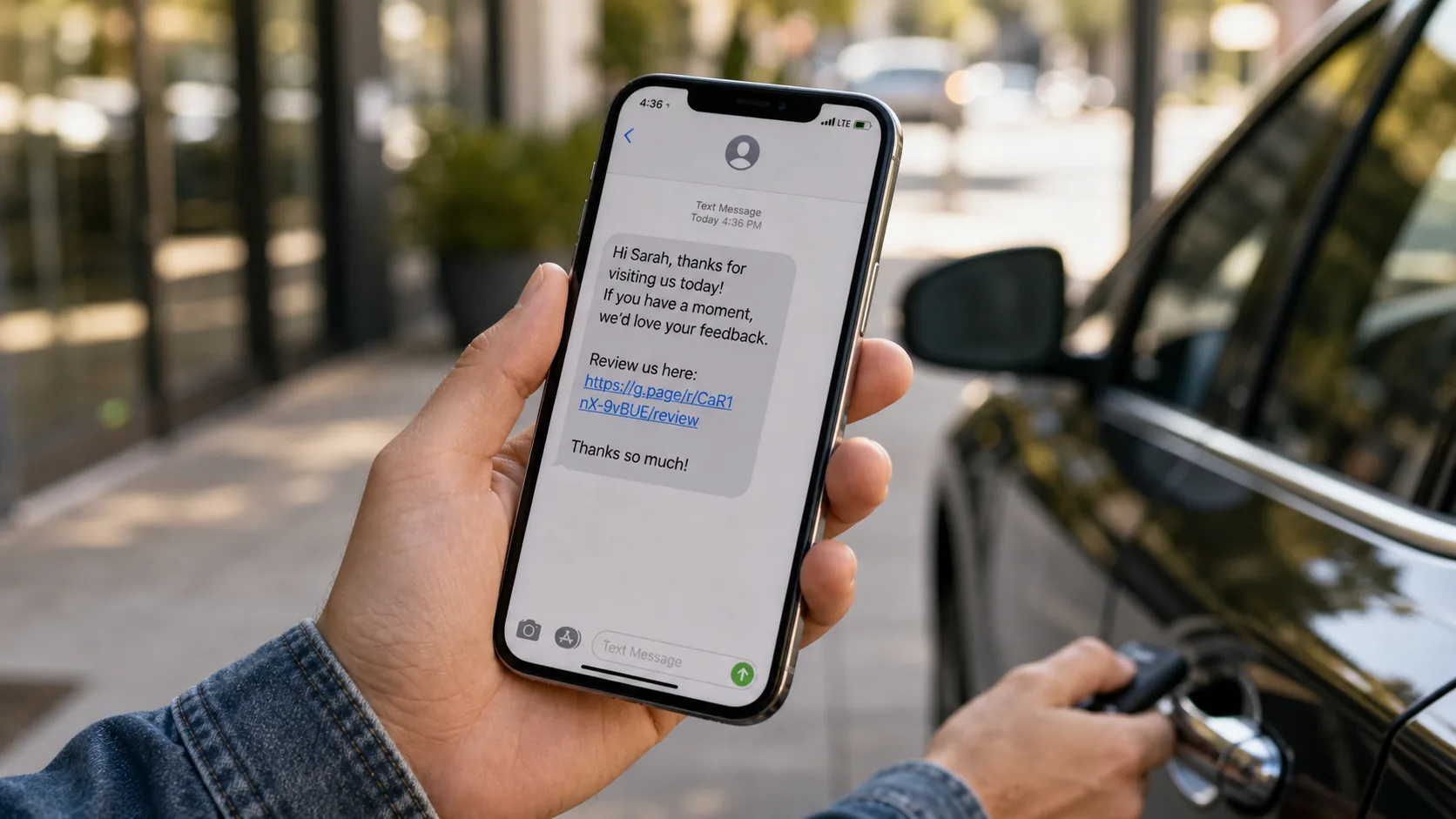
SMS lands inside the warm window because that's where it lives. The notification fires, the phone is already in the customer's hand on the way out the door or in the car five minutes later, the message is two lines long, and the link is one tap away. The entire round trip (message read, link tapped, review written, review submitted) can happen inside three minutes from a parking lot.
The email path is longer at every step. Open the email app, find the right inbox, open the email, scroll past the header image and the company logo, find the link, tap, wait for the page to load, get redirected to Google, sign in if you're not already, write the review. Each of those steps has a non-trivial abandonment rate. By the time you compound them, you're at low single digits.
This is also why "we'll send a weekly review-request email blast" produces almost nothing. The blast strategy guarantees the message will land outside the warm window for nearly every recipient. You're stacking the worst version of channel against the worst version of timing.
What Email Is Actually Good For
None of this means email is useless. It means email is the wrong primary channel for a review request, which is a different claim. There are real situations where email outperforms SMS for this specific job.
B2B services. If your customer is a procurement contact or an office manager, or just someone whose phone number you legitimately don't have, SMS is off the table. Email is the only channel. Conversion will be lower than the numbers above, but it's the right tool for that audience.
Older demographics where you genuinely don't have a mobile number. Some businesses (certain medical practices, financial services, traditional home services in particular markets) have customer lists where 20-40% of contacts have only a landline on file. Texting a landline doesn't go anywhere. Email at least has a chance.
Follow-up after an SMS that got no click. This is the highest-leverage email play I see. SMS goes first, inside the warm window. If the customer didn't click in 48 hours, a short email follow-up two or three days later picks up another 3-5% conversion on the same list. It works because it's a second touch, not because email is better, and because the customer has already received the initial ask in a more personal channel.
Customers who explicitly opted out of SMS. If a customer texts STOP, you don't text them again, ever. (The TCPA section below covers this in more detail.) Email is the legitimate fallback channel for that segment.
Long-form context. If for some reason your review-request flow requires more than two lines (a product-specific question, a multi-step setup, a customer who needs a refresher on what to review), email is the channel that can carry it. Honestly, you should fix the flow so it doesn't need that context, but if you can't, email is the right venue.
For every other category of customer in a local-services business, SMS is the primary and email is the backup. Reversing that order is the most common channel mistake I see operators make.
How to Run Both Without Annoying Anyone
The instinct to "just hit them on both channels" is wrong, and customers can tell when they're being double-pinged. The flow that works treats SMS and email as a sequence, not a salvo.
The sequence I see work best across categories looks roughly like this. SMS goes out 30-90 minutes after the visit, while the warm window is still open. If the customer clicks and leaves a review, the email never fires. If the customer doesn't click in 48 hours, an email goes out: different copy, slightly longer, with the same review link. If they don't engage with the email in another 5-7 days, you stop. No third touch.
That cadence (one SMS, one email follow-up, then quiet) produces roughly 95% of the conversion you'd ever get from this customer without crossing into annoyance territory. Operators who add a third or fourth touch get measurable opt-outs and trivial incremental reviews. It's not worth it.
The other rule is that the two messages shouldn't read like the same message in two channels. The SMS is a thank-you and a link. The email follow-up acknowledges that you reached out before, keeps it short, and invites the customer to share feedback without any sense of guilt-tripping. Something like "wanted to check in once more, and if you have a minute, we'd love to hear about your visit." That's it.
For the mechanics of timing, list segmentation, and trigger logic, the review-request automation guide walks through the operational layer in more detail. The principles are the same regardless of which tool you use to run them.
The TCPA Gotcha Nobody Talks About
Here's the part of the SMS conversation that gets glossed over in most "use texting" advice, and it matters. In the US, the Telephone Consumer Protection Act regulates business text messaging, and the regulatory environment around it has tightened meaningfully in the last few years. Review-request SMS isn't exempt.
The short version: you can send transactional or informational SMS to customers who've given you their number in the course of doing business, but the consent has to be real, the message has to be reasonably related to the transaction, and the customer has to be able to opt out. "Reasonably related" is where review requests live, since they're connected to a recent service interaction. But the consent piece is where operators get into trouble.
Two specific things to watch. First, the customer needs to have actually given you the number for service-related communication: not scraped from a third-party list, not purchased from a lead vendor, and not collected on a form that didn't disclose what you'd use it for. Second, every SMS needs a working opt-out (STOP), and the moment a customer opts out, that number is done across all your messaging, not just review requests.
The other layer is carrier-level regulation. A2P 10DLC registration is now effectively required for any business sending SMS to US customers at any meaningful volume. Unregistered traffic gets throttled, filtered, or blocked entirely by carriers, which means the "we sent 400 messages this month" report from your tool might be wildly disconnected from how many actually landed. Registration isn't optional, and the registration process itself takes a few weeks. My TCPA compliance post walks through the full setup checklist.
None of this is meant to scare operators off SMS. The vast majority of review-request use cases are completely fine under TCPA: the customer gave you their number when they booked, you texted them once after the appointment with a link, you honored opt-outs. That's the legitimate path. The trouble starts when operators import a five-year-old list, blast it cold, and assume nothing will go wrong.
Where to Start if You're Picking One
If you can only run one channel for the next quarter, run SMS. The conversion gap is wide enough that everything else in your review system (message wording, timing, who you ask, profile setup) matters less than picking the right channel in the first place.
Get the post-visit SMS firing on every customer with a phone number on file. Make sure you're registered for A2P 10DLC if you're in the US. Honor opt-outs immediately and automatically. Write the message in two lines with the link last. Send within an hour of the visit ending. That alone, in my experience, takes most local businesses from a trickle of reviews to a steady stream within thirty days.
Once that's running, add the email follow-up for customers who didn't click in 48 hours. That's the cheapest 3-5 extra percentage points of conversion you'll ever get, and it costs you nothing operationally because the flow is already automated. Email becomes the safety net, not the primary channel.
If you're picking a tool to run all of this, the only things that really matter are: does it fire on time (inside the warm window), does it handle the A2P registration for you, does it run the SMS-then-email sequence automatically, and does it stop sending the moment the customer leaves a review or opts out. If a tool can do those four things, it'll outperform most of what's on the market regardless of brand name.
Frequently Asked Questions
Frequently Asked Questions
- What is a good Google review request conversion rate?
- Inside the warm window over SMS, 20-30% of recipients leaving a published review is normal across local-service categories. Email on the same list typically converts at 1-2%. If your SMS is under 10%, the timing or message is wrong.
- Is it legal to text customers asking for a Google review?
- Yes in the US, if you have a real relationship with the customer, the customer gave you their number for service-related communication, every message has a working STOP opt-out, and you are registered for A2P 10DLC. Honor opt-outs across the entire account, not just the campaign.
- How many times should I send a Google review request?
- One SMS within an hour of the visit, and one email follow-up at 48-72 hours if the customer has not clicked. Stop after that. Adding a third touch produces measurable opt-outs and trivial extra reviews.
- When should I use email instead of SMS for review requests?
- Use email when the contact is B2B, when you have only a landline or no mobile on file, after the customer texts STOP, or as the 48-hour follow-up to an unclicked SMS. For every other case, SMS is primary.
- What is A2P 10DLC and do I need it for review request texts?
- A2P 10DLC is the US carrier registration framework for business-to-consumer SMS. Unregistered messages get throttled, filtered, or blocked. Registration is effectively required for any meaningful volume and takes a few weeks to approve.
- Why is my email open rate high but reviews still low?
- Open rate hides the funnel. Even when 20% open the email, only 3% click the review link, and 1-2% actually publish a review. The drop-off is the cost of email landing outside the warm window with extra friction at each step.
Honestly, the channel choice is the highest-leverage decision you'll make in your entire review-generation system, and most operators make it on autopilot in the wrong direction. Pick SMS, get the warm window right, layer email as a follow-up, and stop fighting the data. If you'd rather have it running by next week with the timing, sequencing, and A2P registration already handled, that's exactly what I built ThankYouReview to do.
Keep reading
How to Get More Google Reviews in 2026: A Playbook for Local Operators
A practical, end-to-end playbook for getting more 5-star Google reviews without bribing customers or breaking Google's policies.

How to Respond to Negative Google Reviews (With 12 Templates That Actually Work)
12 copy-and-paste response templates for one-star reviews, plus the framing that turns a complaint into a public win.
Can You Pay for Google Reviews? What Google's Policy Actually Says
Paying for reviews is against Google's policy — but the line between incentive, gift, and bribe is fuzzier than most owners think.