
How HVAC Companies Get More Google Reviews (Field-Tested Playbook)
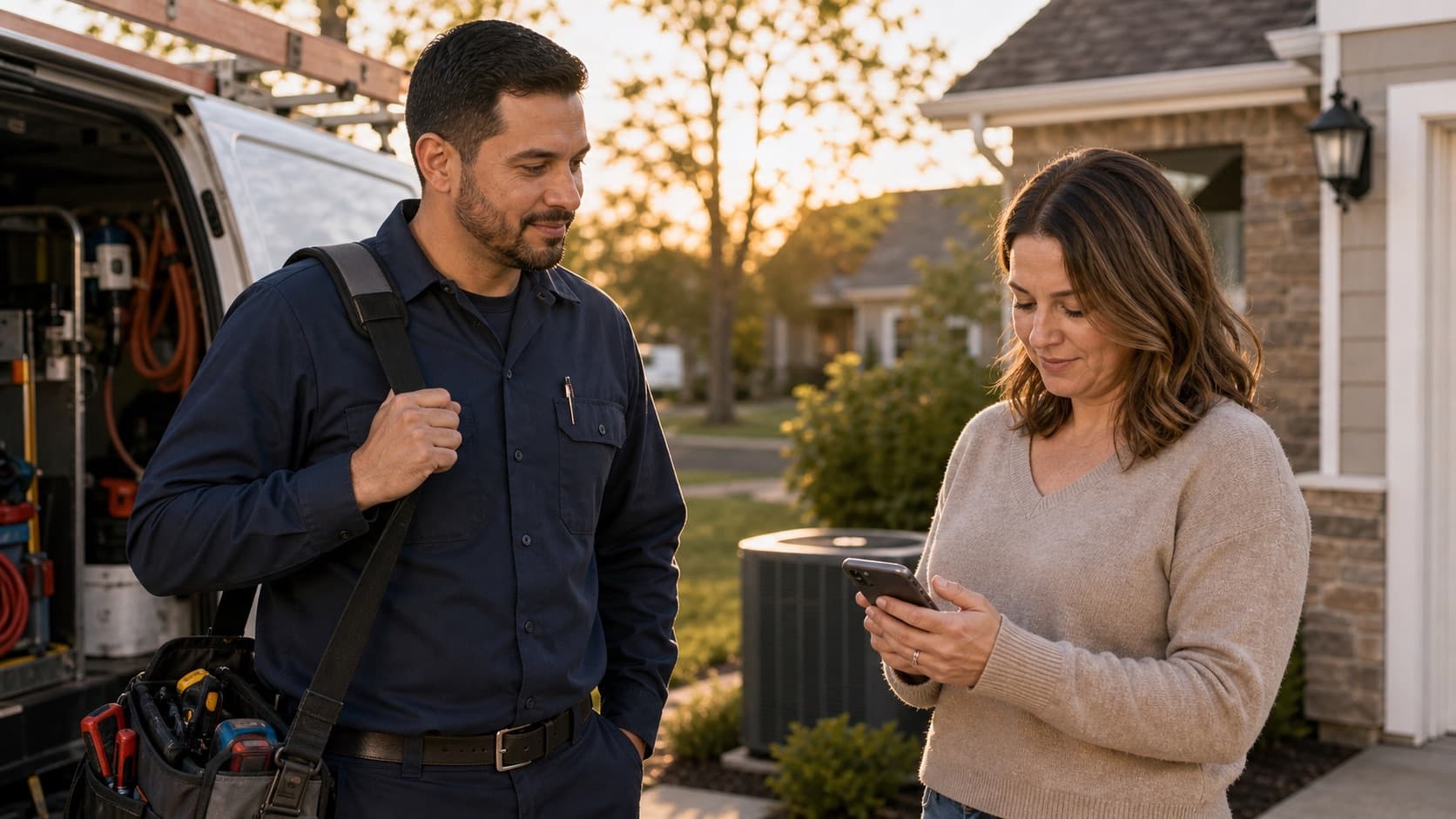
Almost every HVAC owner I talk to lands on the same complaint inside the first ten minutes. "We do eighteen to twenty-five service calls a day in summer, customers love us, half of them hug the tech when the AC comes back on, and we have a hundred and twelve Google reviews after nine years. The plumber across town has eight hundred." Then the real problem comes out. "I keep telling the techs to ask. They don't. They forget. They're already pulling out of the driveway. I'd ask myself if I had time, but I'm running dispatch." The work is great, the customer relief is real, and the ask is locked behind a workforce that just doesn't have time to perform it.
This is the playbook I've watched residential and light-commercial HVAC companies use to go from a slow trickle to a steady three or four reviews a week, without a tech ever having to remember the ask, without the office chasing customers, and without anybody breaking down during peak season when the team is pulling twelve-hour days. It's specific to how HVAC actually runs. The generic "ask after every job" advice falls apart the moment a 6pm emergency call ends at 11pm and the tech has eleven more in the queue tomorrow.
Why HVAC Owners Leave Reviews on the Table
HVAC should, on paper, be one of the highest-converting review verticals in local services. When the tech arrives, the situation is acute. It's a hundred degrees, the house is unbearable, the dog is panting, somebody slept on the couch downstairs because it was the only room with a working window unit. When the tech leaves, everything has changed. The system runs, the house cools, the dog stretches out on the kitchen tile. That's about the biggest emotional swing you'll find in local services. A customer who felt that swing two hours ago will write you the best review of your career, if you ask at the right moment.
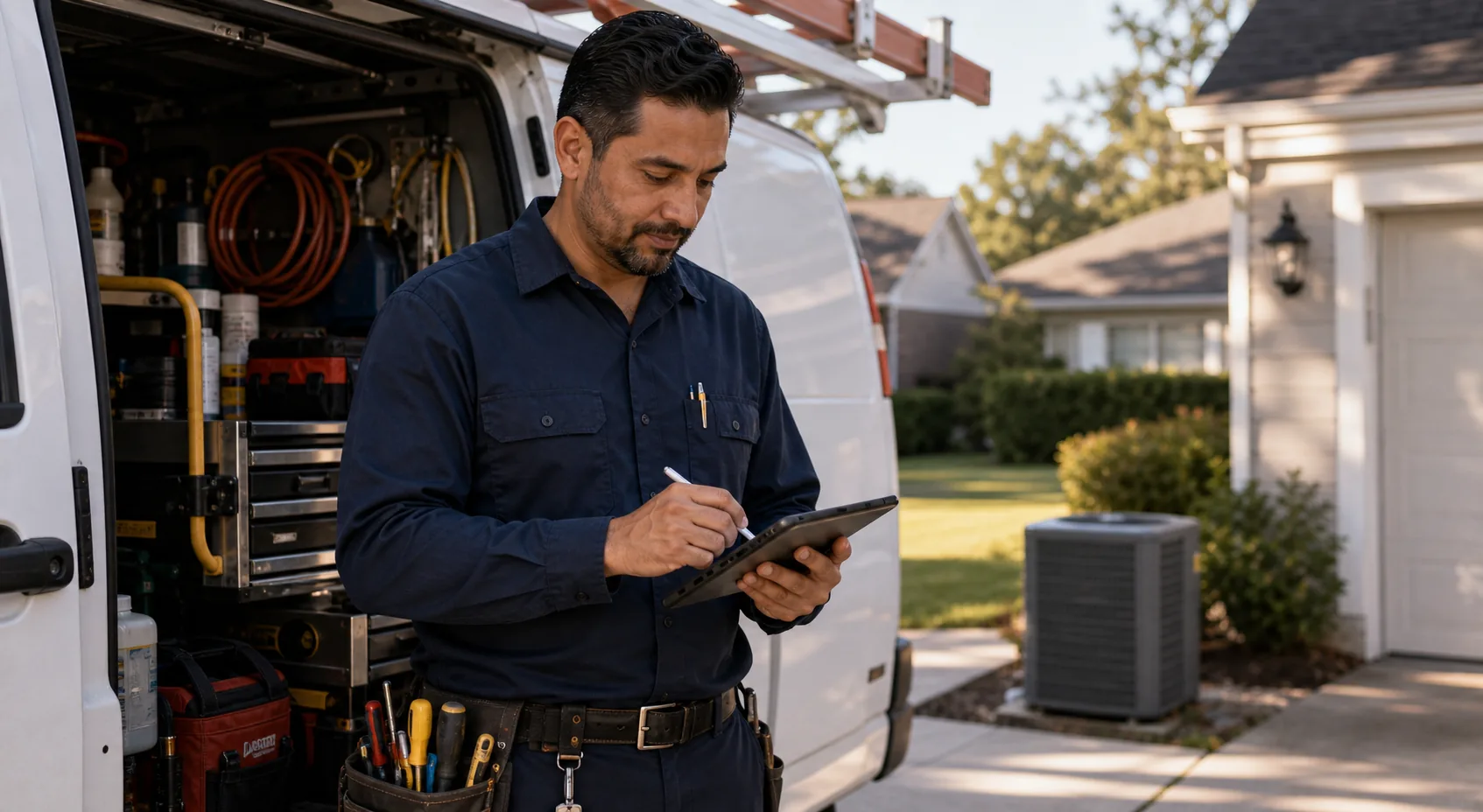
And yet the typical independent HVAC company runs years behind the regional franchises on review count. It isn't workmanship. Nothing in the normal HVAC workday creates a natural moment for the tech to perform the ask. He's writing the invoice on a tablet, the homeowner is signing, the next dispatch is already pinging his phone, the truck is half-loaded for the next call. There's no warm post-job conversation, just a transactional close-out followed by a fast handoff. The ask, if anyone remembers it, gets crammed into the last thirty seconds and feels exactly as forced as it sounds.
Owners who break out of the hundred-review trap stop trying to make the tech ask out loud. They build the ask into the dispatch system, so it fires whether the tech remembers or not.
The Real Reason Techs Don't Ask
Every HVAC owner has had this conversation, badly, in a Monday morning meeting. Techs don't ask because they don't have the cognitive bandwidth. It isn't about training or caring. Field service is a high-load job. The tech is balancing diagnostic logic, customer communication, parts, weather, the next stop, and the invoice math, all at once. A review request is the lowest-priority item on that list. It gets dropped by every tech, every time, the moment the day gets busy, which is the day you most need the reviews.
There's also a softer reason nobody likes to say out loud. The tech feels weird asking. He just spent ninety minutes in a stranger's house, sweated through his shirt in the attic, billed the customer eight hundred dollars, and now he's supposed to ask for a favor on the way out. Even the techs who do ask, ask awkwardly, and that awkwardness costs you the review you would've gotten if the customer had received a clean automated text instead of being put on the spot in her hallway by a sweating guy.
The fix is to remove the ask from the tech entirely. The tech still gets credit. His name appears in the text, the customer thanks him by name in the review, but he never has to perform the request out loud. Dispatch does it for him.
The 30-Minute Window After the Truck Pulls Away
The window when an HVAC customer is most likely to leave a great review is shorter than most owners think, and it doesn't start at job close. It starts about thirty seconds after the truck leaves the driveway.
While the tech is still in the house, the customer is in customer-mode. She's paying attention to the diagnosis, the invoice, the warranty. The moment the truck pulls away, a few things happen in her head, almost universally. The house is visibly cool. The dog flops on the floor. She thinks "thank god that's done." That thirty-to-forty-five-minute stretch is the warm window for HVAC.
For service-call review requests, the highest-converting send time is roughly fifteen to forty-five minutes after job close. Send the same text three hours later and conversion roughly halves. Send it the next morning and it halves again. By forty-eight hours the customer has paid the bill, moved on, and forgotten the emotional spike entirely.
This is why the "send a follow-up email at end of week" approach, which is still what most HVAC office software does by default, produces almost nothing. The fix is the same one I'd recommend across service businesses: SMS, fast, fired automatically from the dispatch close-out event. There's more on the SMS-vs-email gap in our SMS vs email post.
Mentioning the Tech by Name in the Text
This is the single highest-leverage detail in the HVAC playbook, and the one most owners miss the first time they set up an automation.
Google reviews attach to the Google Business Profile, not the individual tech. A lot of HVAC owners hear that and conclude getting techs into the review text is pointless. It isn't. You want the tech's name to appear inside the customer's review text, where Google indexes it and prospective customers absolutely notice.
The mechanism is the request itself. "Thanks for choosing us today, if you have a sec a Google review would mean a lot" gets a generic one-line review back. "Hi Megan, thanks for letting Marcus get your AC running today, a Google review would mean a lot to him" gets reviews that mention Marcus by name around 60-70% of the time. The next homeowner two miles down the road, comparing companies, sees four reviews praising different techs with specifics. "Marcus diagnosed our compressor in five minutes." "Jose was patient with my mom." "Devon stayed late on a Friday to finish the install." That kind of mix is the difference between her calling you or the competitor.
The compounding effect inside the company is what most owners underestimate. Techs notice when their names show up. They start caring about the program in a way no training session ever produced. They'll mention it at close-out: "you might get a text from us in a bit, no pressure, but if my name comes to mind that helps me out." That soft pre-warm, paired with the automated SMS, is honestly the highest-converting combination I've seen.
One trap to avoid is the version where the tech points the review at himself ("leave Marcus a five-star"). The customer hunts for Marcus's profile, can't find one, and either gives up or leaves a Facebook comment that doesn't help your GBP. The text leads with the company link. The tech's name lives inside the message, not in the call to action.
Installs vs Service Calls vs Emergencies
Not every job should get the same flow. The biggest variable is what kind of job it was, because the emotional arc and the visibility of the result are different across the three core job types.
Service calls are the cleanest case. The customer was uncomfortable, the tech came, the problem is solved, the house is cool. Send fifteen to forty-five minutes after job close. This is your highest-volume, highest-converting cohort.
Installs are trickier and pay back longer. A new system install is a much bigger transaction. You're talking three to fifteen thousand dollars, half a day to two days on site, dust and disruption everywhere. The customer isn't fully in the warm window the moment the crew leaves. She's looking at dust on the furniture, double-checking the thermostat, wondering if the unit is supposed to be that quiet. The conversion peak for installs sits twenty-four to forty-eight hours after the crew is gone, by which point she's run the system overnight, she sees the cooling improvement, and she's feeling the relief of the project finally being done.
Emergency calls (after-hours, holiday weekends, the 6am no-cool) are a different animal. The emotional charge is at its peak and the gratitude is enormous. Send at the same thirty-minute window as service calls, but the wording should nod to the emergency. "Thanks for letting Marcus get you back up and running last night" lifts conversion because it cues the customer to write specifically about the emergency response. Reviews like that convert 2am-in-July searches at a much higher rate than generic service-call reviews.
| Job type | First send | Second send | Notes |
|---|---|---|---|
| Routine service / tune-up | 30 min after close | None | Highest-volume cohort, base of the program |
| Diagnostic + repair | 30 min after close | None | Emotional peak is at "house is cool again" |
| Emergency / after-hours | 30 min after close | None | Lean into the emergency framing in the wording |
| New system install | 24-48 hours after crew leaves | None | Wait for the dust and the first overnight |
| Preventive-maintenance visit | Next morning | None | Low-emotion cohort, lower conversion |
| Commercial service call | 24 hours after close | None | Asking the right contact is the bigger challenge |
Commercial Accounts: A Different Conversion Game
Almost every HVAC owner has some mix of commercial and residential, and they all ask the same question once the residential side starts producing reviews. "Can we do this with commercial too?" Yes, but the mechanics are different.
You're not texting the building owner. You're texting the facilities manager or the on-site contact who let your tech in. That person isn't emotionally invested the way a homeowner is. The AC working again is a relief on someone else's behalf, and her job security is more affected by whether your invoice was clean than whether your tech was friendly. A more formal text like "thanks for working with us on the rooftop unit today, a Google review helps our team a lot" converts roughly half as well as the residential version, but the reviews read as B2B-credible to commercial buyers comparing vendors.
Timing is different too. A commercial contact isn't in any warm window. She's at her desk, dealing with five other vendor calls. Twenty-four hours after job close, on the morning of the next business day, is usually the right window. The unit has run overnight, tenants didn't complain, and she's at her desk where the SMS can be paired with a quick email follow-up.
Surviving Summer Peak Without Manual Asking
The months when you most need reviews, when search volume for "HVAC near me" peaks and competitors are marketing hard and new customers are deciding fast based on the Google profile, are the months when nobody on your team has thirty extra seconds. Techs are on twelve-hour days, the office is buried in dispatch, the owner is running emergency calls personally. If the program depends on anyone remembering anything, it produces zero reviews for the three months when reviews matter most.
The fix is to run the post-job SMS off the dispatch system's job-close event, with no human involvement after the tech taps "complete." Modern field-service software like ServiceTitan, Housecall Pro, FieldEdge, and Jobber all emit a webhook at job close. The automation listens, looks up the tech and customer names, picks the right delay, and sends the SMS. The truck pulls away, thirty minutes pass, the phone buzzes.
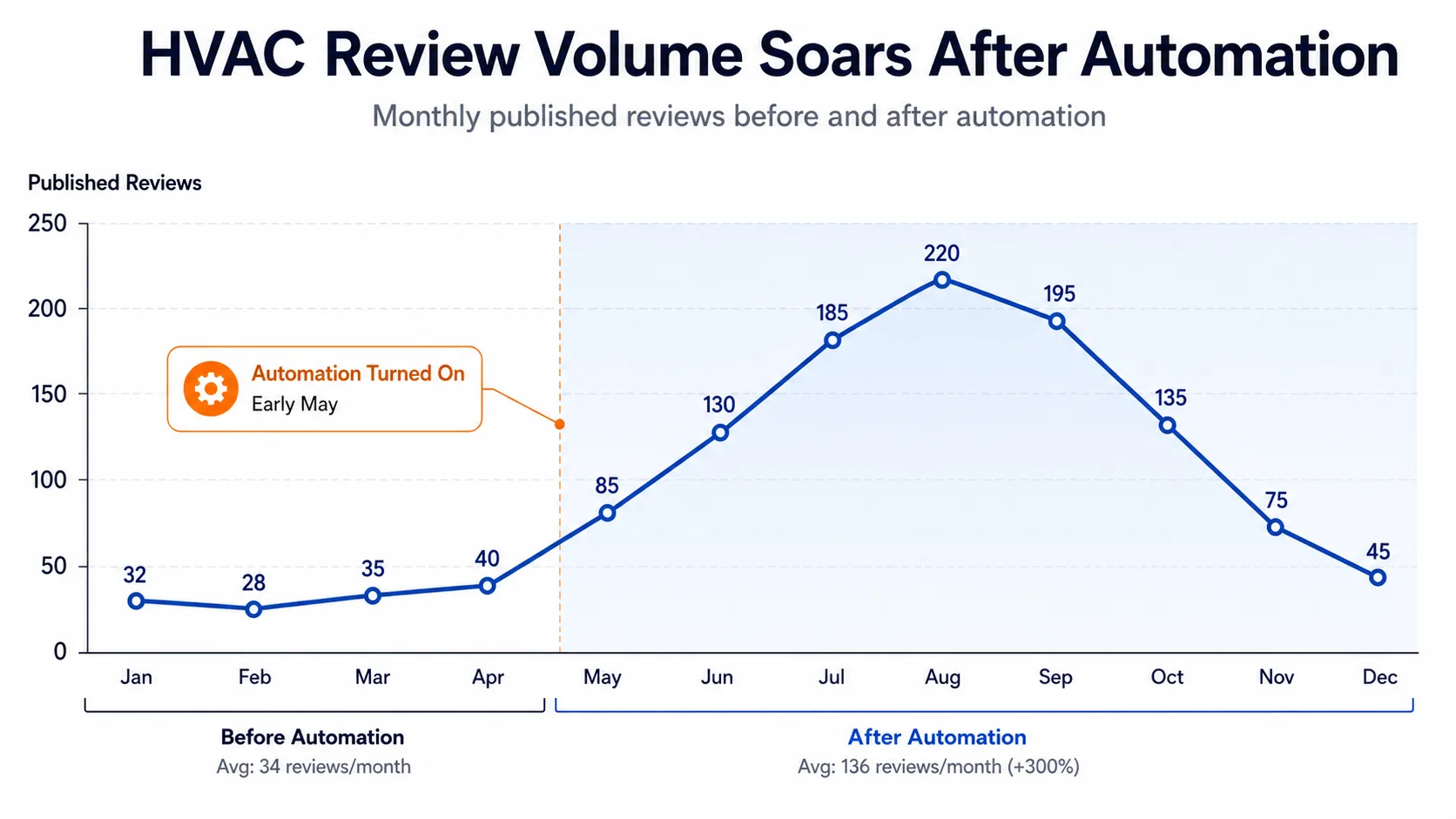
What this gets you is that peak season turns into your highest-review-volume season instead of your lowest. The eighteen-call Tuesday that used to produce zero reviews now produces eighteen requests, ten opens, three or four published reviews. Compound across the ninety-day peak and your Google profile is unrecognizable by Labor Day, right when fall furnace season kicks off and new customers start shopping for the company they'll trust this winter. The technical side of wiring the dispatch event is in our review-request automation guide, and the cross-vertical frame lives in our pillar piece.
What to Tell the Team When You Roll It Out
Every owner who shifts onto an automated review program has roughly the same conversation with the techs in the first week. The techs will ask whether the automation makes them look bad or interferes with the customer relationship. The answer is that the text goes out from the company, mentions them by name, and shows up about thirty minutes after they leave. They don't have to ask out loud. They just have to do the work that makes the customer want to write the review when the text arrives. And when their name shows up in the review (which it will, most of the time), that's a public, indexed credit to them specifically, on the page the next prospective customer in this zip code is going to read.
Techs who care about doing good work start to see the review mention as a public scoreboard, in a way no internal employee-of-the-month program ever achieves.
Frequently Asked Questions
Frequently Asked Questions
- When should an HVAC company send a Google review request after a service call?
- Between 15 and 45 minutes after the truck pulls away. Conversion roughly halves by hour three and collapses to single digits by the next morning. The 'house is cool again' moment is short.
- Should the tech ask for the review in person at the end of a job?
- No. The tech does not have the cognitive bandwidth during a busy day and the in-person ask reads as transactional. Soft pre-warm at close-out is fine; the actual ask should fire automatically by SMS.
- Does mentioning the tech's name in the review text really make a difference?
- Yes. Reviews mention the named tech about 60 to 70 percent of the time. That puts specific names like Marcus or Jose into the indexed review text, which prospects in the same zip code read.
- How long should an HVAC company wait to send a review request after a new system install?
- Twenty-four to 48 hours after the crew leaves. The customer needs to run the system overnight, see the cooling improvement, and feel the relief of the project being done before the warm window opens.
- What field service software supports automated review request triggers?
- ServiceTitan, Housecall Pro, FieldEdge, and Jobber all emit a webhook at job close that an automation can listen to. If your system does not, that is the single highest-leverage gap to fix.
- Should commercial HVAC clients receive the same review request flow as residential?
- No. Commercial contacts are not in an emotional warm window; the right delay is 24 hours, paired with more formal wording. Expect roughly half the conversion of residential, but B2B-credible review content.
None of this requires anyone on the team to do anything different. Techs still diagnose, still install, still close out the invoice on the tablet. Dispatch still routes. The office still answers the phone. The only thing that changes is that the warm window after the truck pulls away, that thirty-minute moment when the customer's house is cool and the dog is finally asleep and the relief is at its peak, stops getting wasted. If you want the dispatch-triggered SMS, the tech-named templates, and the job-type timing delays running by the end of the week, that's the entire reason ThankYouReview exists. Otherwise, pick your highest-volume job type, write one text that mentions the tech by name, wire it to the job-close event in your field-service software, and ship it before next Monday. Reviews don't come from the driveway. They come from the kitchen, thirty minutes after the truck leaves, with the AC finally humming.
Keep reading

How Hair Salons Get More 5-Star Google Reviews (Without Asking Awkwardly)
A salon-specific playbook for getting more Google reviews from chair-side conversations and a tiny bit of automation.

How Dental Practices Get More Google Reviews (HIPAA-Safe Playbook)
A HIPAA-aware approach to review requests for dental practices — what you can and can't say in an SMS, and the wording that converts.

How Med Spas Get More Google Reviews (Without Crossing FDA or HIPAA Lines)
A med-spa playbook for collecting more reviews while staying clear of FDA marketing rules, HIPAA constraints, and review-platform red flags.