
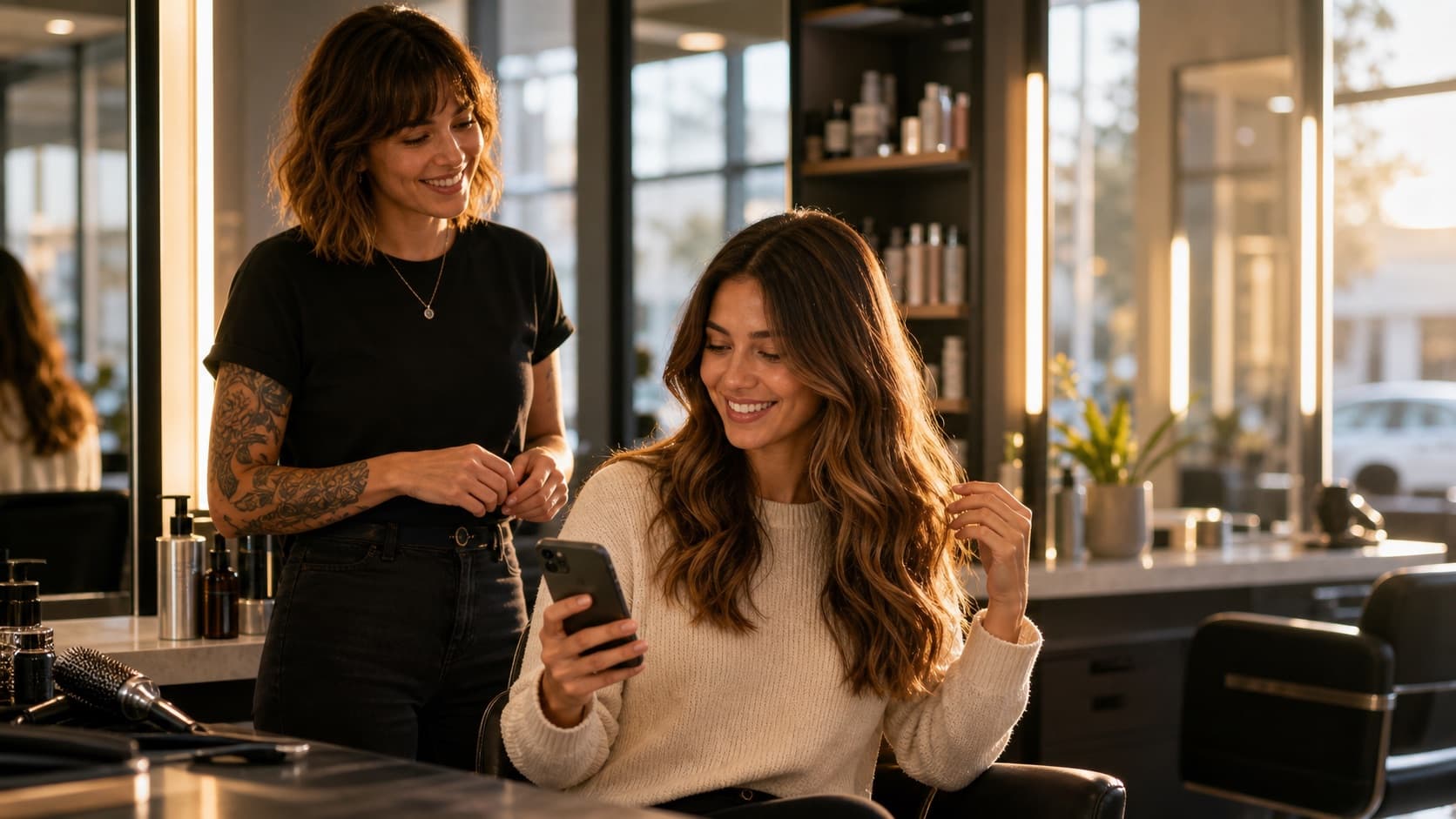
How Hair Salons Get More 5-Star Google Reviews (Without Asking Awkwardly)
Most salon owners I talk to say some version of the same thing. "I know my stylists are amazing, I know our clients love us, they tell us in the chair every single day, and somehow our Google page has thirty-eight reviews after four years." Then they pause and add the part that actually matters: "And I hate asking. It's weird. They're sitting in front of a mirror, I'm holding scissors, we just spent ninety minutes talking about her divorce. I'm not going to pivot into 'hey, mind leaving us a review?'" Honestly, that's the whole problem in two sentences. The service is great, the relationship is great, the ask is broken.
Below is the playbook I've watched salons use to go from one or two reviews a month to three or four a week, without anyone behind the chair ever having to perform the ask out loud. It's specific to the way a salon actually runs (color vs trims, walk-ins vs booked, slow Tuesday vs Saturday rush) because the generic "ask for reviews!" advice falls apart the second you try to apply it to an environment where every appointment is a different length and every stylist has their own book.
Why Salons Punch Below Their Weight on Google Reviews
Salons should, by rights, dominate their local Google Maps results. The service is high-touch, the relationship between stylist and client is unusually personal, and the emotional payoff at the end of a great cut or color is bigger than almost any other local-business transaction. A client walks out feeling visibly better than she did when she walked in. That's a much stronger review-trigger than, say, a successfully unclogged sink.
And yet the typical independent salon has fewer reviews than the dry cleaner two doors down. It's not a service quality problem. It's that the salon environment is the single worst place in retail to ask for a review face-to-face, and most owners (correctly) sense this and just don't ask. The intimacy that makes the relationship great is the same intimacy that makes the ask feel transactional and a little humiliating to perform.
The owners who break out of the thirty-review trap are the ones who stop trying to ask in the chair and start asking somewhere else, automatically, after the client has already walked out the door.
The Chair Conversation Trap
There's a myth in this industry, passed down through every "marketing for salons" webinar, that the chair is where the magic happens. That a good stylist builds rapport during the service, gets the client glowing, and then "naturally weaves in" a request for a Google review while spinning the chair around for the big reveal. I've never seen this work at scale, though I've watched a lot of stylists try.
Here's what actually happens. The stylist finishes blow-drying. The client looks at herself in the mirror, says some version of "oh my god I love it," tips, maybe hugs, walks to the front. Anywhere in that thirty-second window, asking for a Google review out loud requires the stylist to break a tone that took ninety minutes to build. It feels like ending a great date by asking for a Yelp review of the date. Even when the stylist forces themselves through it, the client now feels mildly obligated, and obligation isn't what produces a five-star review with two paragraphs of detail.
There's also a structural problem. Stylists in a busy book don't have time. A color client wraps at 2:45, the next foil is at 3:00, and the stylist is already mixing toner. The mental overhead of "remember to ask Jenna about the review on her way out" gets dropped, every single time, by the third client of the day. You can't run a review program on stylist memory. Nobody can.
The fix is to take the ask out of the chair entirely and put it somewhere the client has already left, the stylist isn't involved, and the prompt looks like a normal text message rather than a small social negotiation.
The 30-Minute Window After Checkout
The window when a salon client is most likely to leave a great review is shorter than you'd think, and it doesn't start when she leaves the chair. It starts when she leaves the building. While she's in the chair she's still mid-experience. While she's at the front desk paying she's transactional. The moment the door closes behind her she's in the car, glancing at the mirror, possibly taking a selfie. That's the warm window.
In my experience the highest-converting send time for salon review requests is between fifteen and forty-five minutes after checkout. That's long enough for the client to be out of the building and looking at the result in natural light, short enough that the emotional charge of the visit hasn't faded. Send the same text three hours later and the conversion rate halves. Send it the next morning and it halves again.
This is why the post-visit SMS approach (sent automatically, anchored to checkout in the POS or booking system) out-performs anything stylists try to do in person. The system doesn't forget. It doesn't get awkward. It hits every client at the moment her hair looks best, which happens to be exactly when she's most likely to write a glowing review.

Putting the Stylist's Name in the Text (and Why It Lifts Conversion)
Google itself doesn't let you tag a specific stylist in a review. The review is attached to the business location, not the staff member. A lot of salon owners hear that and conclude that stylist-level review attribution is just impossible. It isn't. The trick is to make the stylist's name show up inside the client's review text, which Google indexes and which prospective clients reading your page absolutely notice.
The way you do that is in the request itself. A text that says "Thanks for coming in today, if you have a sec a quick Google review would mean a lot" gets a generic review back. A text that says "Hi Megan, thanks for letting Tasha take care of you today, if you have a sec a quick Google review would mean a lot to her" gets reviews that mention Tasha by name roughly 60-70% of the time in my experience. Now Tasha has a discoverable presence on your Google profile. New clients searching for "balayage near me" land on your page and see five different stylists named in real reviews, with detail, and they pick the one whose work the reviewer described in the way they're hoping to look.
This compounds in a way most owners don't anticipate. Stylists notice when their name shows up in reviews. They start caring about the program. They start gently mentioning it themselves, not as a corporate ask, but as "by the way, you might get a text from us in a bit, just so you know it's real." That softer mention, paired with the automated send, is the highest-converting combination I've seen in this industry.
Handling Color-Correction and Long-Service Clients
Not all clients should get the same text. The biggest variable in a salon book isn't who the client is, it's how long they were in the chair. A walk-in bang trim and a six-hour color correction are different emotional events, and the review request should reflect that.
Long-service clients (color corrections, full highlights, extensions installs, keratin, bridal) are your highest-value review targets by a wide margin. They're emotionally invested. They booked weeks in advance. They paid three to ten times what a trim costs. For most of them the result is the difference between hating their hair for a year and loving it. Those are the reviews that fill out a Google page with depth: three-paragraph reviews with before-and-after detail that read as credible to anyone considering the same service.
The send timing for these clients should sit a little later than the standard window. A color-correction client often won't really see her hair until she's washed it the next morning and styled it herself. Sending the request at thirty minutes is fine, but a second prompt the next afternoon (only if she hasn't already left a review) picks up the "wow, it still looks great" moment, which for long-service clients is sometimes more powerful than the day-of glow. Trim clients, by contrast, don't need a follow-up. If the same-afternoon text didn't land, a second message just feels like nagging.
| Service type | First send | Second send | Stylist name in text |
|---|---|---|---|
| Trim / quick service | 30 min after checkout | None | Optional |
| Cut + style | 30-45 min after checkout | None | Yes |
| Color / highlights | 45 min after checkout | Next afternoon if no review | Yes |
| Color correction | 1 hour after checkout | Next afternoon if no review | Yes, strongly |
| Extensions / keratin | 1 hour after checkout | Next afternoon if no review | Yes, strongly |
| Bridal / event | Morning after | None | Yes |
The point of the table isn't that every salon needs seven different flows. It's that a one-size-fits-all "send at 1pm the next day" approach leaves a meaningful amount of review volume sitting on the floor from your most valuable clients.
The Front-Desk iPad Play
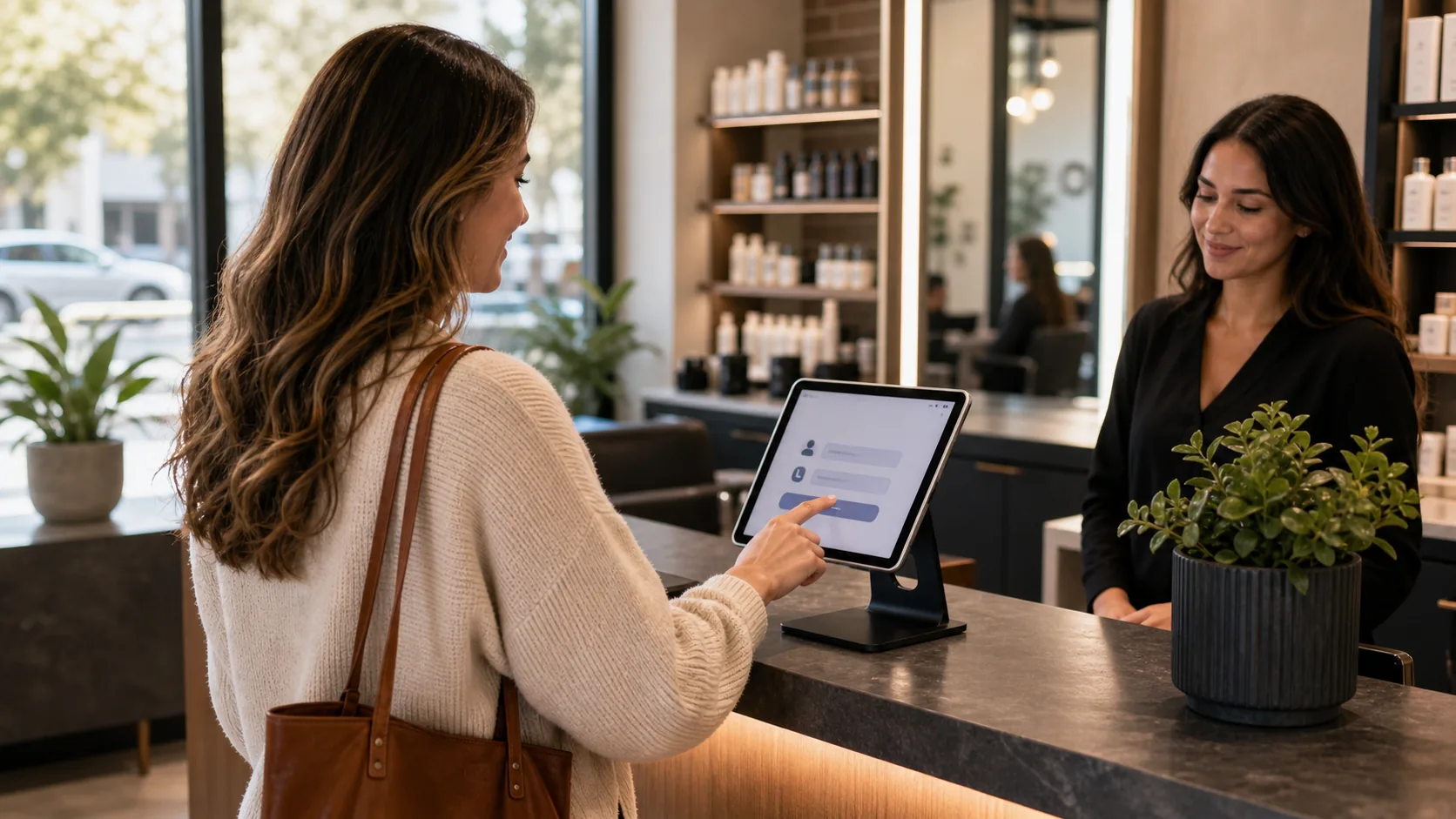
For salons that take walk-ins or have any client who isn't already in the booking system with a phone number on file, an iPad at the front desk is the missing piece. Two taps to capture name and number at check-in, and the client is now in the loop for the post-visit SMS without anyone having to remember to add her. The stylist doesn't have to do anything different. The receptionist doesn't have to perform the ask. The system just runs.
The same iPad does a second job, which is solving the receptionist-handoff problem. In most salons the moment a client checks out is also the moment the phone is ringing, the next client is walking in, and the receptionist is mentally split four ways. Even when the salon has decided "we're going to ask everyone for a review at checkout," the receptionist will, predictably, forget on the busy days, which are the days you most need the volume. Automating the ask off the kiosk check-in removes that single point of human failure entirely.
For booked-only salons that don't take walk-ins, you don't strictly need the iPad. The booking system already has the phone number. But you do need to make sure the post-visit SMS fires off the appointment-completed event in the booking software, not off a manual "did this client check out?" toggle. The same memory problem hits the front desk at appointment close. Wire it to the calendar event itself.
There's a longer discussion of the kiosk approach in our pillar piece on getting more Google reviews, and the technical side of the automated send is in our review-request automation guide.
What to Say When a Stylist Asks "Is It Weird That I'm Asking for Reviews?"
This question comes up in every salon team meeting where review programs get rolled out, and it's a fair one. The honest answer to give the team: yes, it's weird if you ask in the chair. That's why we don't ask in the chair. The text goes out automatically after she's left, and it mentions you by name so she knows it's tied to her experience with you. You don't have to do the ask out loud. You just have to do the work that makes her want to leave the review when the text arrives.
What stylists can do, optionally, is a soft mention on the way out. Something casual like "you might get a text from us in a bit, no pressure at all, but it really helps me out if you have a sec." That's not asking for a review, that's pre-warming the SMS. It takes three seconds, it doesn't break the tone of the appointment, and it lifts conversion on the text by another 10-15% in my experience.
What stylists should never do is peek at the rating before the review is published, or steer unhappy clients away from leaving public feedback. That's review gating. Google calls it deceptive, and it's the fastest way to get reviews filtered or your profile flagged. If a color client is unhappy, the right move is to fix the color, not to intercept the review. There's a separate post on responding to negative reviews when they do come in, because they will, and how you respond publicly often matters more than the review itself.
Why This Matters More for Salons Than Almost Any Other Vertical
There's a reason I keep pushing salon owners on this even when they're doing fine on word-of-mouth. The vertical where Google reviews drive new bookings most directly is, by a meaningful margin, hair. A prospective client searching "balayage near me" or "best curly hair salon [city]" is doing the most visually-driven, most review-dependent local search in the entire local-services category. She isn't comparing prices. She's comparing reviews, photos, and how stylists are described, and picking the one place where the recent reviews sound like the look she wants.
A salon with eighty recent, detailed, stylist-named reviews wins that comparison against a salon with thirty stale reviews every time, even when the stale-review salon is technically better. Bookings flow to the page that looks alive. And the page that looks alive is the one with a system running behind it.
The compounding effect is the part most owners underestimate. Every week the system runs you add three or four reviews. Three months in, your Google profile reads completely differently than it did when you started. Six months in, you've passed the next salon up the street. Twelve months in, you're the default option in your zip code for the services your stylists are best at, because the reviews now describe exactly that work, in client language, in a way Google indexes and ranks.
Frequently Asked Questions
Frequently Asked Questions
- When is the best time to ask a salon client for a Google review?
- Between 15 and 45 minutes after she walks out the door. That window catches her in natural light, often in her car, when the hair looks best and the experience is freshest.
- Should stylists ask for reviews in the chair?
- No. The chair conversation is the wrong place. Asking face to face during checkout reads as transactional and burns the rapport the stylist just spent 90 minutes building. The automated post-visit text out-performs it.
- Can a stylist get personal credit for a Google review of the salon?
- Reviews attach to the business, not the stylist, but including the stylist's name in the request text gets the name into 60 to 70 percent of resulting reviews. Google indexes that text and prospective clients see it.
- How many Google reviews does a hair salon need to rank well locally?
- Volume matters less than recency and language match. A salon with 80 recent reviews mentioning specific services and stylists will out-rank a 300-review salon whose last review was a year ago.
- Is it against Google policy to offer a discount for a review?
- Yes. Google explicitly prohibits incentivizing reviews. Offending salons risk having reviews filtered out and the entire profile flagged. Ask for the review, never trade for it.
- How should a salon handle a one-star color-correction review?
- Respond publicly within 24 hours, acknowledge the disappointment, offer a private path to make it right, and never argue specifics. Prospective clients read the response more than the review itself.
None of this requires anyone in your salon to do anything they don't already do. Clients still walk in, stylists still do the work, receptionists still check them out. What changes is that the warm window after checkout (the thirty-minute glow when she's looking at her hair in the car mirror) stops getting wasted. If you want the SMS, the iPad check-in, and the stylist-named templates running by the end of the week, that's the entire reason ThankYouReview exists. Otherwise, pick the timing window for your highest-value service, write one text that mentions a stylist by name, and ship it on Monday. The chair conversation isn't where reviews come from. The car ride home is.
Keep reading
How Dental Practices Get More Google Reviews (HIPAA-Safe Playbook)
A HIPAA-aware approach to review requests for dental practices — what you can and can't say in an SMS, and the wording that converts.
How Med Spas Get More Google Reviews (Without Crossing FDA or HIPAA Lines)
A med-spa playbook for collecting more reviews while staying clear of FDA marketing rules, HIPAA constraints, and review-platform red flags.

How Veterinary Clinics Get More Google Reviews (Even With Grieving Clients in the Mix)
A veterinary-specific approach to review requests that respects grieving clients, busy staff, and the realities of a clinical day.