How Coffee Shops Get More Google Reviews (Counter-First Playbook)
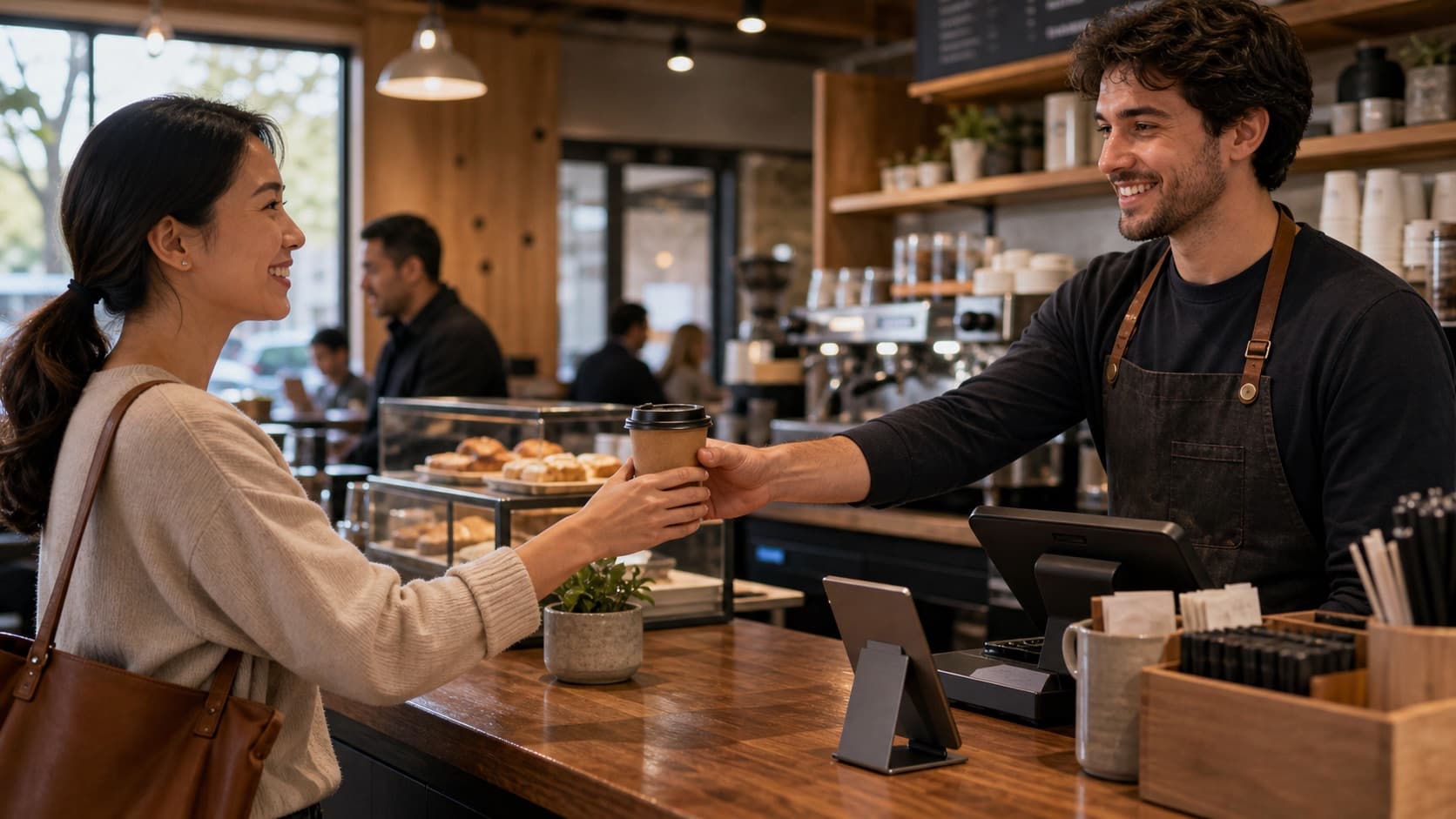
Every independent coffee-shop owner I talk to says some version of the same thing. "We've been open four years, we've got a line out the door every Saturday, our regulars are basically family. And Google says we have sixty-one reviews. The Starbucks across the street has 1,400." Then the part that actually matters: "I can't slow down the line. If we add ten seconds per customer at 8:15 on a Saturday, we're done. I'm not going to ask a guy to leave a Google review with nine people behind him waiting for a cortado." Honestly, that's the whole problem. The product is great, the affection is real, and the line speed is sacred.
Below is the playbook I've watched independent shops use to go from a stalled review count to a steady stream each week, without anyone behind the bar slowing a single order. Coffee is a weird vertical. You've got the speed-of-line constraint, the regulars-versus-tourists split, the to-go-versus-stay dynamic, and the lack of phone numbers on most transactions. The system below is built around how a shop actually runs at 8:15 on a Saturday.
Why Coffee Shops Punch Below Their Weight on Google
Coffee shops should be dominating Google Maps in their neighborhoods. The product is high-frequency, the customer base is overwhelmingly phone-native, and the affection regulars feel is deeper than almost any other local-business relationship. People plan road trips around third-wave shops. And yet the typical independent has a fraction of the Google reviews of the dry cleaner two doors down.
It's not a service quality problem. It's that every review playbook ever written assumes you have the customer's phone number, and coffee shops, almost uniquely in retail, don't. The dentist has it. So does the salon. Even the takeout pizza place has it. The coffee shop doesn't, because the transaction is fundamentally anonymous: card tap, drink in hand, out the door. You can't text someone a review request if you never had a way to ask for their number.
The obvious tools most operators reach for don't work. A printed sign by the register, a "leave us a review!" sticker on the tip jar, a QR taped to the espresso machine. None of these respect the one constraint that runs your business.
The Speed-of-Line Constraint
Before any tactic matters, the operational reality has to be respected. The morning rush is a thing of beauty and terror. One or two baristas on bar, a register person, a line stretched past the pastry case, the pace set entirely by ticket throughput. Anything that adds friction to that flow gets vetoed by staff inside a week, no matter how good the intentions.
This is why "ask at the register" fails immediately in coffee. The register person is taking orders, modifying drinks, processing payments, calling out names. A verbal "would you like to leave us a Google review?" might survive a slow Tuesday at 2 PM. It will not survive 8:15 on Saturday, which is when half your weekly transactions happen.
The corollary is that any mechanic requiring the customer to do something during the transaction also fails. A QR on the menu board? The customer is in line, not scanning, trying to remember if their friend wanted oat milk. A printed receipt with a review link? Half of customers decline the receipt and the other half crumple it. The mechanic has to live outside the order window.
What works is the inversion: a near-zero-friction opt-in during the transaction, and the actual review prompt after the customer has left the line.
The Counter-QR Tap-to-Text
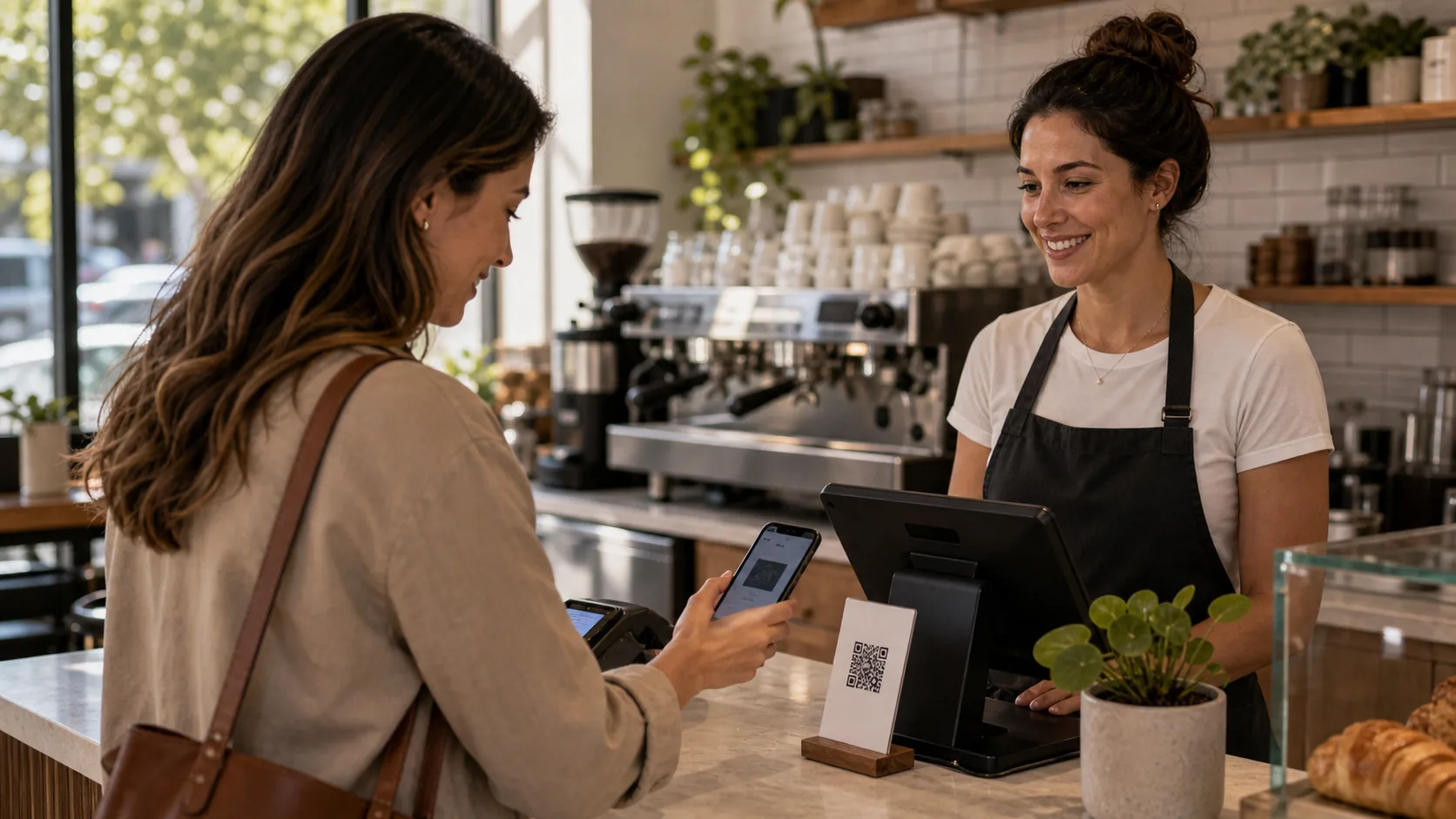
This is the highest-leverage mechanic for the coffee category and almost nobody uses it. The shape is simple. A small, well-designed QR card next to the register or on the bar. Not "leave us a review," but something like "tap here for shop updates and we'll text you a thanks for coming in." The customer taps with their phone camera. Their phone opens a pre-filled SMS to your business number with "hi" or "join." They hit send. Opted in. They walk away with their drink. Thirty minutes later, sitting on a bench drinking it or at their desk halfway through, they get an SMS that says "thanks for stopping in, if you have a sec a quick Google review would mean a lot."
The reason this works in coffee is that it respects the line-speed constraint completely. The customer's interaction during the transaction is one tap of their phone camera. Zero typing, zero conversation with the register person. The register person doesn't have to do anything except point at the QR if asked. The line doesn't slow. And the customer has given you their phone number with a clean opt-in. That's the TCPA-compliant way to handle this, and honestly the only way that doesn't risk a complaint later.
The review request lands thirty minutes after opt-in, which is the warm window for coffee. The customer is mid-drink, thinking about how good this latte is. A short text with the Google link as the first tappable element converts at 20-30%, which for a shop doing 400 transactions a day is enormous even if just 5% of customers opt in at the counter.
There are usually three places this goes wrong. First, the QR is too generic. "Scan to leave a Google review" gets the existing fan and does nothing for the new tourist. The QR has to offer something benign in exchange (shop updates, beans on bar this week) so scanning feels like opting into the shop. Second, operators pair the tap-to-text with a long-form signup of name, email, phone, birthday, which collapses opt-in rates. One tap, one send, no form. Third, they send the SMS too quickly. Thirty minutes is the sweet spot. Five minutes reads as automated, three hours is too late.
The mechanics of running this are covered in our review-request automation guide, and the broader case for SMS over every other channel is in the pillar piece.
Loyalty-Card SMS Opt-In: The Quiet Best Moment
If the counter-QR is the highest-volume mechanic, the loyalty-card signup is the highest-affinity one. It's also the single best moment in a coffee shop to capture a phone number, and almost every shop that runs a loyalty program leaves this on the table.
A customer signing up for loyalty has decided they're coming here more than once. They're a high-affection signal by definition, handing you their info in exchange for points. Asking for a phone number as part of signup feels completely natural. It's how every loyalty program works. The opt-in for "we may text you about rewards and occasionally check in after a visit" is the most defensible TCPA-compliant capture in the category, because the customer is actively asking to be in a relationship with you.
What you do with that number is where most shops fall down. It sits in a loyalty database that talks to no other system. The customer gets a "you've earned a free drink!" SMS twice a year and otherwise nothing. They never get a post-visit review request, because the loyalty system has no idea when they visited. It only knows when they redeemed.
The fix is connecting the loyalty number to the visit event. If your POS knows the customer scanned their card on a given transaction, that's a visit event, and that event can fire a thirty-minute-delayed review SMS to the same number. Loyalty customers produce the best reviews in the entire category. Most affection, most context, the kind of detailed write-up that makes a new tourist scrolling Maps think "oh, this is the place."
The mistake here is asking loyalty customers too often. Every visit is overkill. A three-times-a-week regular doesn't want three review texts a week and will start to feel surveilled. Every fourth or fifth visit is about right, with the SMS varying slightly. Across a base of two hundred loyalty members, that's a meaningful stream of fresh, detailed reviews, exactly the recency signal Google's local algorithm rewards.
Regulars vs Tourists: Two Cohorts, Two Tactics
These two groups want different things and leave different reviews, and most operators run one program for both.
Regulars are your highest-affinity reviewers. They've been coming for months or years, they know the baristas by name, and when they leave a review it's a detailed write-up mentioning a specific drink, a specific staff member, a specific reason they keep coming back. These reviews are gold, and not just because they're glowing. Google indexes them with the language a prospective customer searches in: "flat white," "oat milk," "study spot," "good wifi." The loyalty SMS path above is built for regulars, and it's where the highest-quality reviews come from.
Tourists matter for a different reason. A tourist isn't going to leave a long-form review. One cappuccino, no context for a paragraph. But the tourist is searching "coffee near me" from their hotel right now, and your review count is the most visible signal on that result. The tourist isn't a great review producer. They're the audience the regulars' reviews are written for. A shop with 400 recent reviews from regulars wins the tourist search every time against a 60-review shop, even when the 60-review shop is technically better.
So you don't need a separate tourist program. You need the regulars program running well enough that the tourist's search lands on a profile that looks alive. The one tourist-specific tactic worth running is a small cup-sleeve sticker. Not "leave us a review!" but something like "first time? glad you stopped in. @yourhandle and on Google." Some scan, most don't. The ones who do leave short five-star reviews that boost recency without much content depth, which is exactly what you want from this cohort.
Saturday Morning Is Your Whole Week
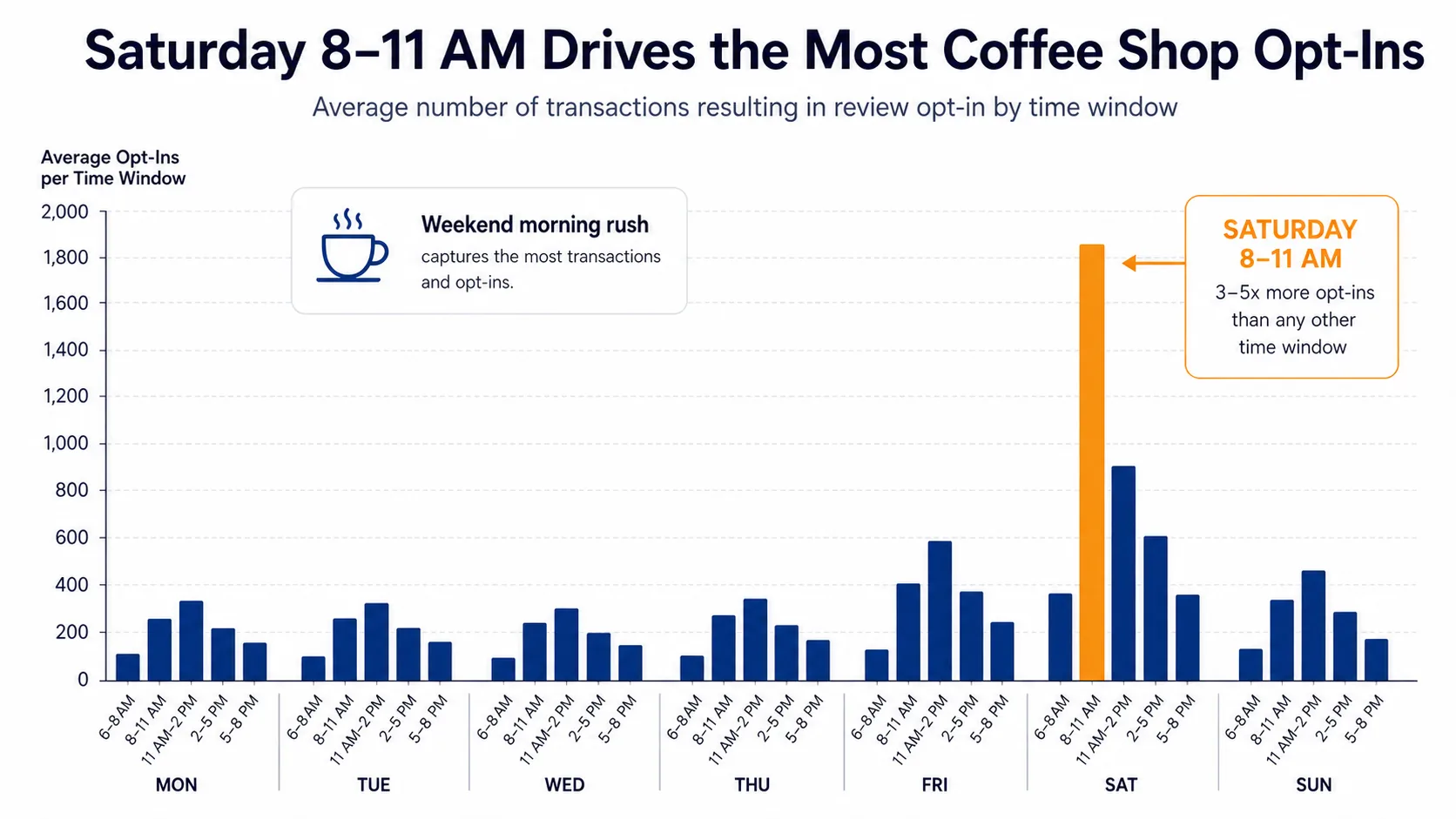
Day of week matters more in coffee than almost any other category. Coffee transactions aren't evenly distributed. Saturday morning between 8 and 11 AM is, for most shops, the single highest-volume window of the week. Some shops do 30% of weekly transactions in that one window. Which means Saturday is also when 30% of your weekly opt-ins happen, 30% of your weekly review SMS go out, and 30% of your weekly reviews get written.
The Saturday morning experience disproportionately drives your Google profile for the entire week. A slow line, a bad pull, a barista in a bad mood on Saturday will shape what every tourist searching on Tuesday afternoon sees. Same the other way: a clean, fast Saturday produces the bulk of your weekly velocity, and you can coast midweek.
The lesson isn't to obsess about Saturday. It's to make sure the system is wired and running before Saturday hits. QR cards stocked, tap-to-text flow tested end-to-end, SMS sender paid up and not throttled, Google review link going to the right place. I've seen shops break their own systems on Friday afternoon (someone removed the QR card because it was "in the way" of a new pastry display) and then wonder why Monday's count was zero. Saturday morning is your whole week.
Same goes for seasonal-launch moments. The day the pumpkin spice cortado or new winter blend hits the menu carries disproportionate review-trigger energy. High-affinity customers are excited, social channels are pushing the product, in-shop traffic is up. Run the opt-in as hard on launch days as on Saturdays. Those days produce the reviews that say "the new fall blend is incredible," which is the kind of search term you couldn't pay to rank for.
What Not to Do (Tip Jar Stickers, Etc.)
A short tour of the things almost every coffee shop tries first, and quietly abandons within a quarter:
| Tactic | Why it fails |
|---|---|
| "Leave us a Google review!" sticker on the tip jar | Customer is paying, distracted; conversion is essentially zero |
| Printed receipt with QR | Half of customers decline the receipt; the other half crumple it |
| Verbal ask at register during rush | Slows line, burns out staff, dies within a week |
| Free-drink-for-a-review offer | Violates Google's incentive policy; gets reviews filtered or removed |
| Once-a-month email blast | Lands in promotions, gets archived unread, warm window long closed |
| Generic "scan to follow us" QR with no SMS path | Captures no contact, no follow-up possible |
The incentive one is worth dwelling on because it's tempting and catastrophic. Offering a free pastry or drink for a Google review violates Google's policies. At best the reviews get filtered out of your visible count, at worst the entire profile gets flagged. The penalty far outweighs the upside. Same goes for "leave us five stars" signage. Google's algorithm pattern-matches it and discounts the reviews that follow. Ask for the review, don't ask for the rating.
The other failure mode worth flagging is the punch card with a phone number field that nobody connects to anything. A lot of shops collect numbers on loyalty signups, never wire them to a visit-event SMS, and never get a single review out of them. The number on its own is useless. It has to be paired with a real visit-detection event in the POS and a thirty-minute delayed SMS. If you have the numbers but no system wired to them, you're sitting on the highest-leverage asset in the shop and getting nothing from it.
For the dine-in version of these tactics, especially around the bill-fold and the takeout SMS, see our restaurant guide. A lot of the same principles transfer, but the speed-of-line constraint in coffee is more extreme, which is why the playbook diverges sharply at the counter.
Frequently Asked Questions
Frequently Asked Questions
- How can a coffee shop ask for Google reviews without slowing the line?
- Put a tap-to-text QR at the counter that the customer scans during the transaction with no register-staff involvement. The actual review SMS fires 30 minutes later, when the customer is mid-drink and not blocking the bar.
- Is it TCPA-compliant to text a coffee shop customer who tapped a counter QR?
- Yes, when the tap-to-text mechanic is structured as an explicit opt-in. The customer sends an SMS from their own phone to the shop number, which is the cleanest form of consent. Do not extract POS numbers and text them.
- When should the post-visit review SMS land?
- Roughly 30 minutes after opt-in. Five minutes reads as automated and intrusive. Three hours is past the warm window. The mid-drink moment is the conversion peak.
- Should coffee shops offer a free drink in exchange for a Google review?
- No. Google explicitly prohibits incentivized reviews. Offending shops have reviews filtered out of the visible count and risk the entire profile being flagged. Ask for the review, never trade for it.
- How often should loyalty members receive a review request?
- Every fourth or fifth visit, not every visit. A regular coming in three times a week does not want three texts a week. Vary the wording slightly and rotate sparingly.
- Why does Saturday morning matter so much for a coffee shop's review program?
- Many shops do roughly 30 percent of weekly transactions in the Saturday 8 to 11 window, which means 30 percent of weekly opt-ins and reviews come from that period. Test the system on Friday afternoon, not Sunday morning.
None of this requires you to change how the bar runs or how the line moves. The pours still happen, the rush still rushes, the regulars still get their usual without saying it out loud. What changes is that the counter has a small, well-designed tap-to-text QR, the loyalty program is actually wired to the POS visit event, and the Saturday morning experience produces the review velocity it should have been producing all along. If you want the QR, the loyalty SMS path, and the thirty-minute review-request flow live by the end of the week, that's the kind of assembly ThankYouReview was built for. Otherwise, pick the single counter mechanic that works for your space, ship it before Saturday, and let the mid-drink moment do the work the line speed never lets you do at the register.
Keep reading

How Hair Salons Get More 5-Star Google Reviews (Without Asking Awkwardly)
A salon-specific playbook for getting more Google reviews from chair-side conversations and a tiny bit of automation.
How Dental Practices Get More Google Reviews (HIPAA-Safe Playbook)
A HIPAA-aware approach to review requests for dental practices — what you can and can't say in an SMS, and the wording that converts.

How Med Spas Get More Google Reviews (Without Crossing FDA or HIPAA Lines)
A med-spa playbook for collecting more reviews while staying clear of FDA marketing rules, HIPAA constraints, and review-platform red flags.