How Auto Detailing Shops Get More Google Reviews (Mobile + Storefront Playbook)
Talk to any detailer with a real book and you'll hear some version of the same story. "I spent six hours on that Tahoe. Full interior, paint decon, two-stage polish, ceramic. The guy was almost crying in the driveway. Three weeks later I checked Google. Nothing. Not a review. Not a star." The work was incredible, the customer was thrilled, the ask just never happened. That's the entire problem with reviews in the detail business. It isn't a service problem. It's a timing problem.
This is the playbook I've watched detail shops and mobile operators use to go from a trickle of reviews a quarter to three or four a week, without anyone having to perform the awkward ask out loud at the end of a job. Detail is unusual. You've got the reveal moment, the trust-with-keys dynamic, the long-service ceramic customer, the recurring maintenance client. The playbook below is built around those specifically, not generic local-services advice.
Why Detailers Leave the Easiest Reviews on the Table
Detailers should dominate Google. The emotional payoff at the end of a great detail is one of the biggest in all of local services. A customer hands you a Honda that smells like a wet dog, and a few hours later you hand back something that looks better than the day they bought it. There's no comparable before/after in any other home-service vertical. The emotional charge is enormous, and it peaks in about a 90-second window.
And yet most independent detail shops sit at twenty to forty Google reviews after years of operation. It isn't a service-quality problem. Detailers, especially the good ones, are wrecked by the end of a job, covered in compound, and the last thing on their mind at hand-off is asking for anything. They've already given the customer the reveal, the walk-around, the cure-time spiel. Asking for a review on top of that feels like one more transaction in a moment that's supposed to be the emotional high point.
Detailers who break out of this start with one insight: the ask doesn't have to happen at hand-off, and it really shouldn't happen out loud. It should happen fifteen to thirty minutes later, by text, automatically, while the customer is still in the driveway with their phone out taking pictures of the car they just got back.
The Reveal Moment Is Your Review Moment
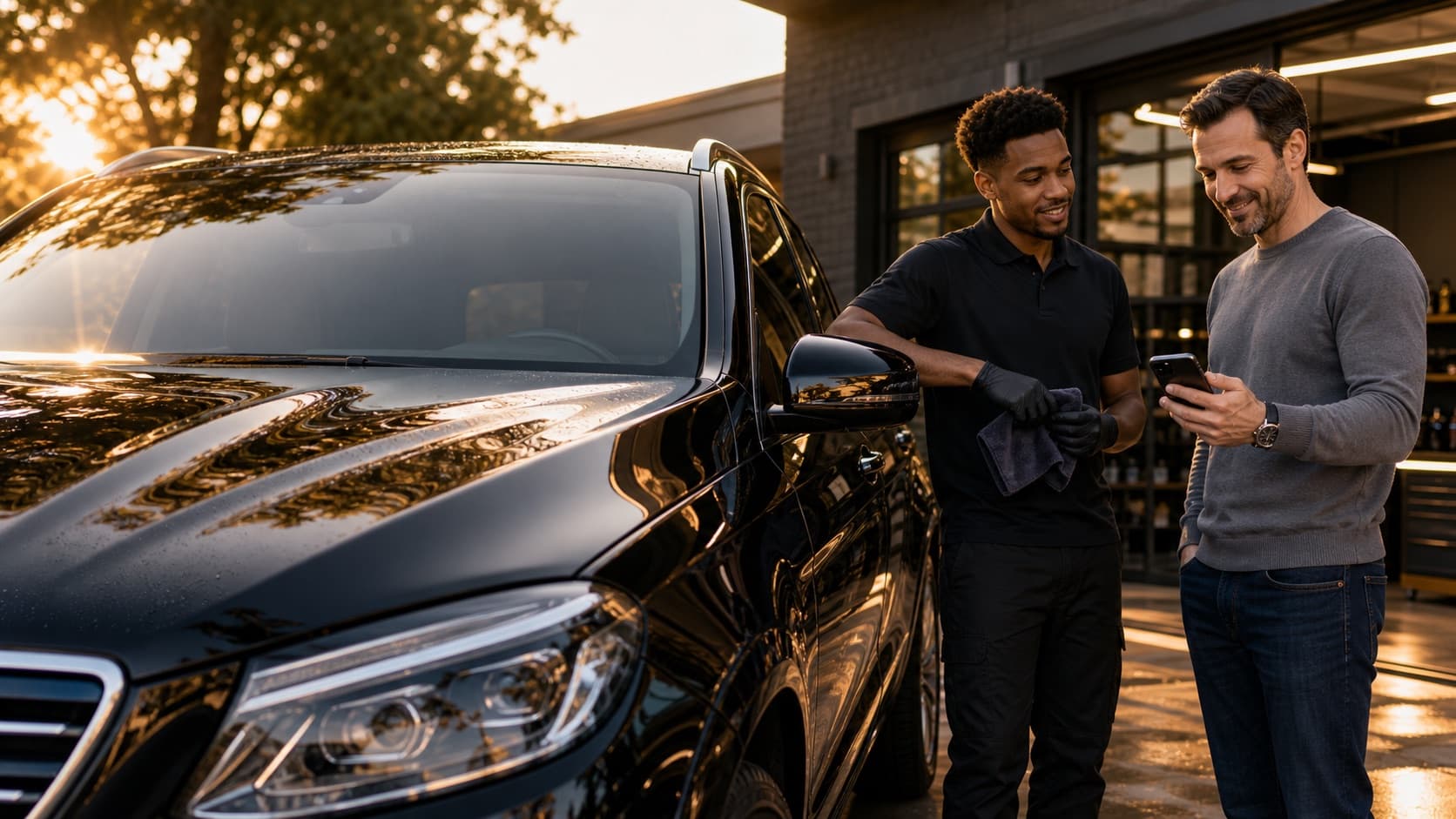
Every detailer knows the reveal. It's the second the customer sees the finished vehicle in good light. Clean, dressed, glossy. Their face changes. They walk around the car slowly. They take a picture. Sometimes they FaceTime their spouse. By a wide margin, this is the highest emotional moment in your entire customer relationship, and it lasts about ninety seconds.
The mistake almost every detailer makes is treating the reveal as the end of the job. It isn't. It's the beginning of the review window. From the reveal to about four hours later, the customer is in a state you don't see anywhere else. They paid you real money, they got something visibly transformative back, and they'd write you a glowing review if a phone-friendly prompt landed in front of them. After four hours the car fades into the daily flow, the kid spills a juice box on the back seat, and the warm window closes.
This is why the playbook below comes down to one principle: get a short, link-first SMS in front of the customer while the reveal is still alive in their head. Where most operators get it wrong is thinking the ask has to happen at the moment of the reveal, in person. It doesn't. The customer doesn't need to be looking at the car for the ask to work. They just need to have been looking at the car in the last hour. There's a wider treatment of why this timing matters across local services in our pillar piece on getting more Google reviews.
Mobile Detail: The 15-Minute Window
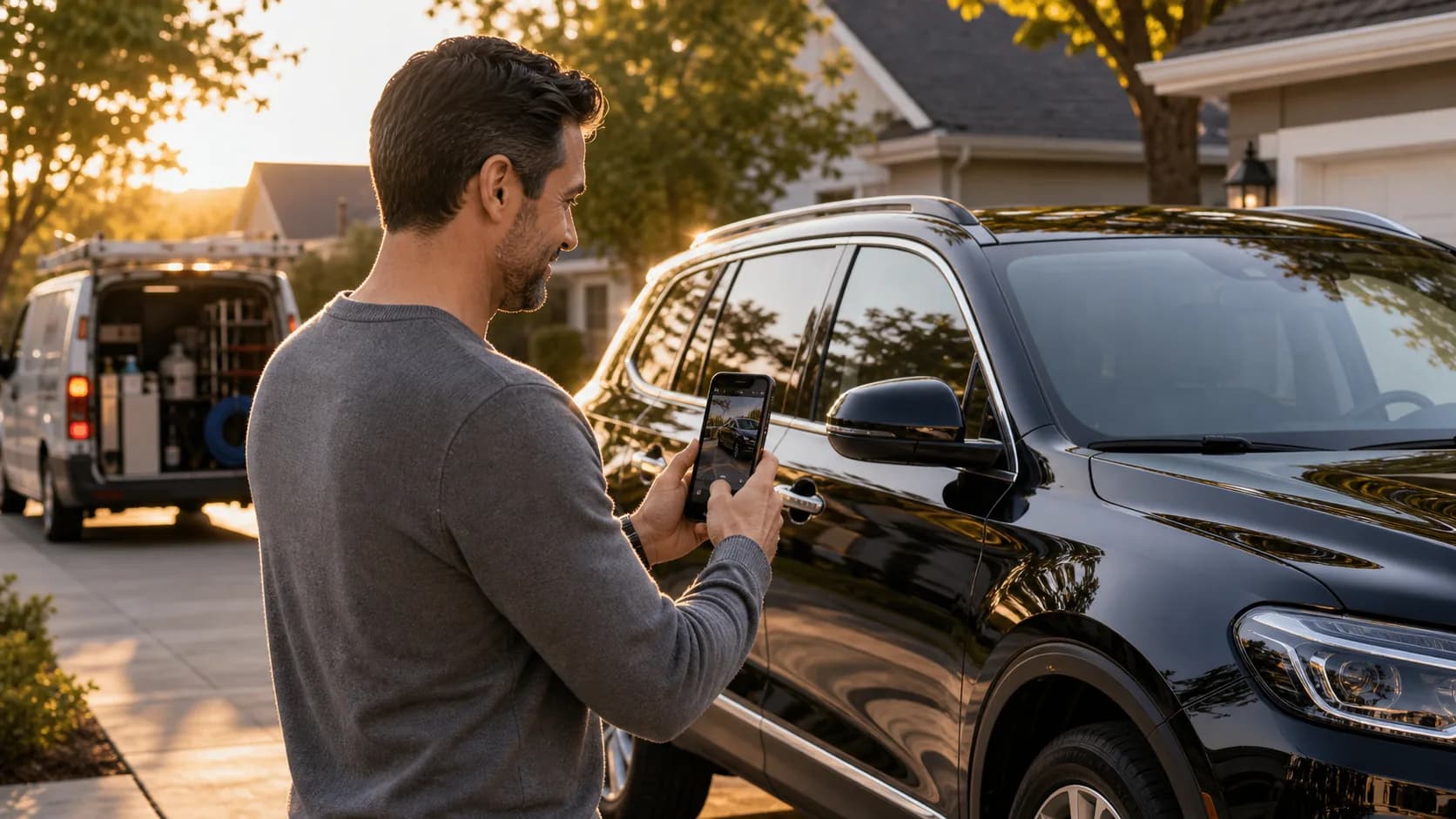
For mobile detailers, the geometry actually works in your favor. When you finish a mobile job, you pack up, do the walk-around, collect payment, and drive off. The customer is now standing in their driveway looking at a car that ten minutes ago was a mess. They've got nowhere to be. Their phone is in their hand. They're probably already photographing the car. This is the most efficient review window you'll find in local services, and almost no mobile detailer captures it.
The play is an automated SMS that fires fifteen minutes after job close, while you're on your way to the next stop. Fifteen minutes is the sweet spot. Long enough that you're not pulling out of the driveway as the text lands (which feels coordinated), but short enough that the customer is still standing near the car or about to text their spouse the photo. The text shows up, they tap the Google link, and they leave a review while the smell of leather conditioner is still in the cabin.
The text itself should mention something specific you did. "Thanks again for letting me take care of the Tahoe today, that interior was a project, glad it came out clean" gets a review that mentions the interior, the dog hair, the kid car seat. Specifics in the prompt produce specifics in the review, and detailed reviews are what new customers searching "mobile detailing near me" actually read. The mechanics of why SMS dominates this window are covered in our review-request automation guide.
The trap for mobile operators is leaning on memory. You finished the job, you got paid, your brain has already moved to the next stop. The SMS has to fire off the job-close action (invoice marked paid, calendar event closed) automatically, without your involvement. If it requires you to remember, it won't happen.
Shop Detail: At-Pickup vs Post-Pickup
For shop-based detailers the timing is harder. Customers pick up at the end of the day, often in a rush, often after work, often with a kid in the back seat of the loaner. The reveal still happens, but the warm window starts in a more compressed and distracted way than it does for a mobile job in their own driveway.
The temptation is to ask at pickup, in person, while you're showing them the work. Don't. The customer is mentally splitting between admiring the car, processing the maintenance instructions, and figuring out logistics. Layering "and if you have a sec, could you leave us a Google review" on top of that is the same mistake a salon stylist makes in the chair. The moment is too dense, even though the emotional charge is high.
The right move is to wait thirty minutes. The customer pulls out of your lot, drives home, parks in their own driveway, walks around the car one more time in their own light. Then the SMS lands. The text references the car specifically ("thanks for bringing the F-150 in today, hope you're happy with how the leather came out") with the review link as the first tappable element. Conversion on a thirty-minute-post-pickup SMS usually sits comfortably above 25%, several multiples of what the same shop gets from a printed thank-you card or a once-a-month email blast.
One operational note. Capture the phone number at intake, not at pickup. At pickup the customer is in a hurry. At intake they're handing you their keys and walking through what they want done. They're already cooperative, and asking for the number is just part of the work order. Most shops already collect it but bury it on a paper form. Get it into a system that can fire an SMS at vehicle-ready and you've solved 80% of the problem.
Ceramic and Paint Correction: The 48-Hour Sweet Spot
Ceramic-coat and multi-stage paint-correction customers are a special case, and they produce the most valuable reviews you'll ever get. They paid $800 to $2,500 for a one-or-two-day service, they were emotionally invested before you even started, and the review they leave will be the longest and most credible on your profile. New customers shopping for ceramic work read those top to bottom. One great ceramic review is worth ten "thanks, great job!" trims.
The timing here is different though. At pickup the coating is still curing. The customer is told not to wash the car for seven days. They drive home gently. They don't actually experience the ceramic until the next day, when they see how water beads on the windshield in the morning, or how the paint looks at a stoplight in bright sunlight. That's when the real review-trigger moment hits, and it isn't at pickup.
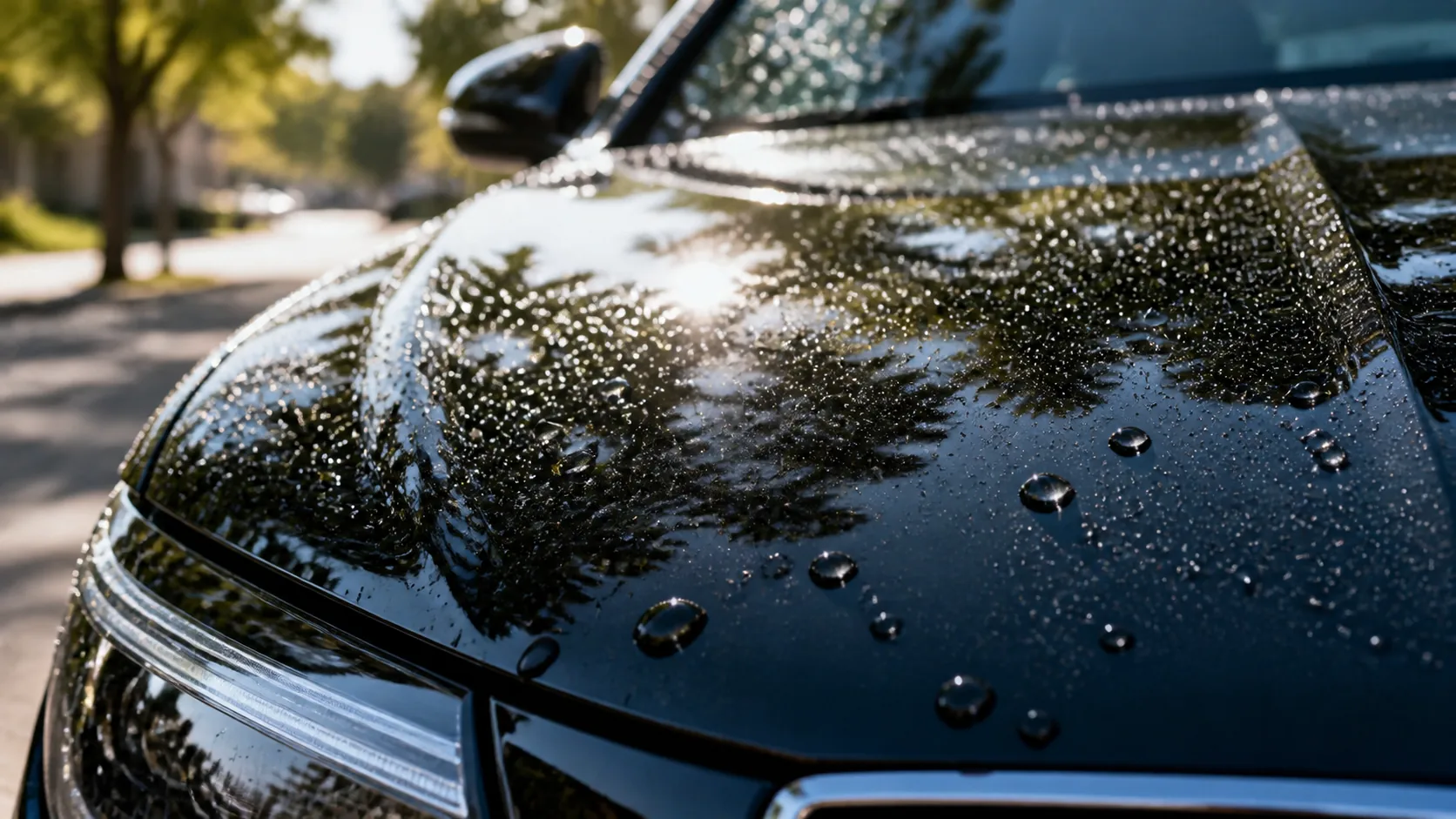
The send window for ceramic and paint-correction clients is 48 hours after pickup. A one-line SMS works: "hope you're enjoying how the M3 is looking out in the sun, if you have a sec a quick Google review would mean a lot, and any photos you've taken are welcome too." That last line is doing real work. Ceramic customers take pictures. A Google review with a customer-uploaded photo of beading water on their hood is honestly the most credible piece of marketing your shop can have, and Google indexes review images in local-pack carousels.
For trim, wash, or one-step polish customers, don't send the 48-hour follow-up. It's overkill and reads as nagging. The 48-hour wait is specifically for the curing-and-sunlight window, and it's only worth doing for the services where that window is real.
Photos, Videos, and the Cross-Pollination Effect
Almost every detail shop runs an Instagram. Almost none connect Instagram to Google reviews, and that's a mistake. The customer who posts their freshly-corrected hood on Instagram is the customer most likely to leave a glowing Google review. They're already in the "show off the car" mindset. Surface both asks in the same warm window, in the same SMS.
In practice, when the post-job SMS goes out, include a soft line about photos. "If you grab a shot, tag us @yourhandle and we'd love to repost." One line, two platforms, neither one mandatory. Customers who don't want to do either will ignore both. Customers who do one usually do the other.
The compounding effect is real. A Google profile with eighty recent reviews, half with customer-uploaded photos, looks completely different to a prospect than thirty stale reviews and no images. They don't analytically think "more social proof." They feel, scrolling through, that this is a place doing real work, recently. That feeling drives the call.
Recurring Customers: The Velocity You're Missing
Most detail shops think of reviews as a one-per-customer event. Ask once, got it or didn't, move on. That framing leaves enormous volume on the table for any shop with a maintenance-detail program or recurring monthly book.
Google's algorithm cares about review recency almost as much as count. A profile with 200 reviews from three years ago ranks worse than a profile with 80 where the last twelve landed in the last month. Recurring customers are your best source of fresh velocity. They're already on the books every 30 to 60 days.
The play is to send the post-visit SMS on every visit, not just the first. Most automation systems default to "only on first appointment." For maintenance customers that's wrong. As long as the text varies and the cadence isn't every two weeks, a monthly client getting "hope it came out well, appreciate any feedback on Google when you have a sec" every other visit will leave two or three reviews a year instead of zero, stacked across calendar months in a way Google's freshness signal rewards.
| Service type | First send | Second send | Photo prompt |
|---|---|---|---|
| Mobile wash / quick detail | 15 min after job close | None | Soft |
| Shop wash / express | 30 min after pickup | None | Soft |
| Full interior / two-step polish | 30 min after pickup | None | Yes |
| Ceramic coating | 30 min after pickup | 48 hours later if no review | Yes, strongly |
| Paint correction (multi-stage) | 30 min after pickup | 48 hours later if no review | Yes, strongly |
| Recurring maintenance | Every other visit, 30 min after | None | Optional |
The point isn't that every shop needs six flows. It's that "send a text the day after" is the wrong default for at least half of these services, and the higher-value the service, the more the timing detail matters.
A quick note on Yelp before we wrap, because detail is one of the categories where it still comes up.
A Note on Yelp vs Google for This Vertical
Detail is one of the few local-service categories where Yelp still moves volume in some metros (Bay Area, LA, parts of the Northeast). Everywhere else, Google Maps is doing 90% of the discovery work. Your post-visit SMS should link to Google, full stop. Yelp's filter is aggressive and routinely suppresses SMS-prompted reviews. You'll spend more time fighting filtered reviews than collecting visible ones. If a customer leaves a Yelp review unprompted, great. Don't build a system around it.
One last industry-specific thing because it shapes how reviews read in this category. When a customer leaves their car with you, they're handing over a $30,000 to $200,000 asset and trusting you with the keys, the garage opener, the registration in the glove box. That trust shows up in detail reviews more than almost any other category. Words like "honest," "trustworthy," "didn't try to upsell me," "respectful of my car." A text that ends with "thanks for trusting us with the Porsche today" produces reviews that name the trust dynamic explicitly. Prospects shopping for ceramic work are nervous about handing over a car they love, and reviews like "they treated my GT3 like their own" are the ones that close the call.
Frequently Asked Questions
Frequently Asked Questions
- How long should a mobile detailer wait to send the review request?
- Fifteen minutes after job close. The customer is still in the driveway, the car looks new, and the phone is already out. Earlier feels coordinated with the truck pulling away; later loses the warm window.
- When should a shop-based detailer send the review SMS?
- Thirty minutes after pickup. That gives the customer time to drive home, walk around the car in their own light, and arrive in the moment when the review writes itself.
- Why send a second text after a ceramic coating?
- The ceramic result is not fully visible until the customer sees water beading on the hood and paint depth in bright sunlight, which happens 24 to 48 hours later. The follow-up text catches that exact moment.
- Should auto detailing reviews link to Yelp or Google?
- Google, in nearly every market. Yelp's filter is aggressive and routinely suppresses SMS-prompted reviews. A few coastal metros still get incidental Yelp traffic, but Google Maps drives 90 percent of discovery for this vertical.
- Can a detail shop ask the same recurring customer for reviews more than once?
- Yes, sparingly. Every other visit is the right cadence for monthly maintenance clients. Google rewards recency, and a recurring base is the easiest source of fresh reviews most shops never use.
- Where should the phone number be captured for the SMS to work?
- At intake, not at pickup. Customers are cooperative when handing over the keys and rushed when getting them back. Intake forms that capture phone solve 80 percent of the problem.
None of this requires changing how you actually detail cars. The reveal still happens, the hand-off still happens, the customer still drives away amazed. The only thing that changes is that the warm window after they leave (the fifteen-minute mobile window, the thirty-minute shop window, the 48-hour ceramic window) stops getting wasted. If you want the SMS, the photo prompt, and the per-service timing rules running by the end of the week, that's what ThankYouReview was built for. Otherwise, pick the highest-value service on your menu, write one short text that names the car by make, and ship it on the next ceramic pickup. The reveal is yours to capture, but the driveway afterward is where the reviews actually get written.
Keep reading

How Hair Salons Get More 5-Star Google Reviews (Without Asking Awkwardly)
A salon-specific playbook for getting more Google reviews from chair-side conversations and a tiny bit of automation.

How Dental Practices Get More Google Reviews (HIPAA-Safe Playbook)
A HIPAA-aware approach to review requests for dental practices — what you can and can't say in an SMS, and the wording that converts.

How Med Spas Get More Google Reviews (Without Crossing FDA or HIPAA Lines)
A med-spa playbook for collecting more reviews while staying clear of FDA marketing rules, HIPAA constraints, and review-platform red flags.